1. Foreword
Are you ready for a future where artificial intelligence (AI) will assign your work tasks, evaluate your performance and help you solve problems and navigate challenges at your workplace? Having an AI as a manager is no longer science fiction – it’s already becoming part of everyday working life. According to our research1, as many as 49% of Finnish knowledge workers and experts say they’ve already encountered AI-driven management in their own jobs.
AI has taken on many roles in expert work, serving as an assistant, team member, editor, brainstorming partner, mentor, and, as many say, a “trusted colleague”. However, alongside these familiar roles, AI has increasingly begun to assume a new and less-studied role: that of a manager and leader. Although the idea may seem strange at first, upon closer consideration it may not be an impossible or even undesirable change. What if your manager was always present and available? What if it could adapt to your competence and needs, based on your personal work data? This is not merely a question of technology, but also of what form that management will take in the era of AI.
In this book, the concept of “AI as a manager” refers to algorithmic management: the partial or complete transfer of decision-making and managerial tasks to automated systems, digital tools, or AI. This phenomenon has previously been studied primarily in the context of the platform economy, for example in connection with apps such as Wolt and Uber, warehousing, and telemarketing – environments where algorithms have long played an important role in the allocation, evaluation, and steering of work. Our book focuses on a new and poorly understood setting: algorithmic management in expert and knowledge-intensive work. Expert and knowledge-intensive work refer to work that relies on specialised expertise, independent judgment, problem-solving, and the creation and application of knowledge. Examples include consultants, engineers, software developers, researchers, HR professionals, lawyers, and other professionals whose work depends primarily on knowledge, analysis, and decision-making rather than routine manual tasks.
When we consider fields in which work is based on judgment, creativity, and interaction, the role of AI in management raises fundamental questions. The theses presented in this book are based on research data on Finnish workplaces from 2025–2026 and, taken together, they provide a more complete picture of how AI is also reshaping the management of expert and knowledge-intensive work.
This book provides perspectives especially for the strategic and operational management of organisations, HR functions, and people working in expert and knowledge-intensive work. Its aim is to help us all understand algorithmic management as a phenomenon and identify the value it can bring, as well as the risks it may carry. As it becomes a daily part of working life, the real question isn’t whether to use it, but how to use it sustainably, without losing sight of the business goals or employee wellbeing. Our goal is to consider how the opportunities presented by AI in management can be seized responsibly while still respecting and strengthening the well-being of individuals and work communities. International examples have shown that not all forms of algorithmic management would even be possible, let alone desirable, in a Finnish context.
As an example, Amazon has long since adopted AI-based monitoring systems to monitor the pace, productivity, and AI use of its software developers. According to some news sources, the introduction of these AI-assisted systems has been linked to productivity expectations that are several times higher2. At the same time, work is being increasingly evaluated on the basis of automated data and algorithmic indicators, transferring management powers from people to systems.
Regulation in Finland and the European Union (EU) has also set clear limits for algorithmic management. For example, under Finnish law, camera surveillance may not be used to monitor individual employees, and the monitoring of employees’ location data is also strictly limited, requiring a legitimate justification and prior notification to the employee3,4. At the EU level, regulation related to algorithmic management has already become a key issue, and in the future, the rules concerning it will be shaped significantly. Nonetheless, legislation alone cannot answer the question of which values will underpin the future of management or how the values of Nordic society – trust, autonomy, and participation – can be translated into the operating principles of AI-based managers.
At the start of this book, we will explain what algorithmic management is and how it is used in Finland today, especially in expert and knowledge-intensive work. Next, we will examine what kind of added value algorithmic management can bring to organisations, and the experiences companies have had with this phenomenon. Finally, we will summarise our key research observations for work communities, present our recommendations for actions, and outline the potential future of algorithmic management.
We invite you to use this book to reflect on the form that management takes when the role of AI is extended from supporting work to actively managing it.

“AI as a Boss” is not a story that pits humans against machines – rather, it’s about how we can grow human capabilities alongside technology, and how new tools can bestow us with new kinds of professional superpowers.
Sami Masala, Founder and Managing Director of AIThink
1.1 The process behind this book
This book is based on a multi-stage research and development process, the goal of which was to understand the significance, opportunities, and limits of algorithmic management in Finnish expert and knowledge-intensive work. It was created as part of Haaga-Helia’s “RoboBoss – AI in the Leadership of Knowledge Work and Expert Roles” project (2025–2026).
The study was carried out in stages between 2025 and 2026, combining quantitative and qualitative data with future-oriented foresight.
In the first stage, in spring 2025, we carried out a national survey for experts and knowledge workers in different fields. The aim of this stage was to form an overview of the current state of algorithmic management, its perceived added value, and its impacts on everyday work. In addition, we wanted to identify key opportunities and obstacles to algorithmic management in expert and knowledge-intensive work. The survey was repeated and supplemented in spring 2026, when it was specifically targeted at managers and supervisors to deepen the study’s perspectives on management.
The second stage, in autumn 2025, involved a future-oriented Delphi panel for managers and supervisors. The panel consisted of two questionnaire rounds, with parallel workshops conducted between the first and second round. The aim of this stage was to examine the future prospects of algorithmic management in expert and knowledge work. The panel focused particularly on the impacts that algorithmic management will have on the organisation of work, leadership roles, and the future structures of expert work.
In the third stage, in spring 2026, we brought together the materials and conclusions drawn from the previous stages. These were validated and enriched in organisation-specific research, development, and innovation workshops at five companies. The workshops’ materials consisted of outputs produced by the participants, joint tasks, and the researchers’ observations. This final stage aimed to produce concrete recommendations for developing algorithmic management in work communities, provide strategic managers with information on the opportunities and limits of algorithmic management in expert organisations, and offer application developers insights into how experts should be consulted in the design of management systems.This book brings together the key observations from these different stages and presents them in an easily digestible and accessible format. Its aim is to support the application of our research findings in practical working life. We also reflect on the results from the perspectives of management, workplaces, and organisational development, and present recommendations for examining algorithmic management in a responsible and purposeful manner.
How we utilised AI in the research and writing process
Generative AI applications, such as Microsoft Copilot, OpenAI’s ChatGPT, and Anthropic’s Claude, were used to help analyse research findings, structure text outputs, and produce summaries to support the authors’ work. In particular, AI was used to streamline the text, improve structural clarity, and produce alternative wording.
However, the authors are solely responsible for their research-related interpretations and conclusions, as well as all final decisions on the book’s contents. AI was used as an aid, not a decision-maker – much in the same way as the technologies examined in this book at best support, but do not replace, human judgment and responsibility.

2. How algorithmic management works, or how people can be managed by AI
Algorithmic management is radically changing the way we manage work as workplaces move further away from management models that rely on individual humans5. At the same time, it challenges us to rethink what management means and what kind of role human supervisors will play in the age of AI. When we examine the relationship between AI and work, two distinct perspectives emerge: firstly, AI can support work by offering analytics and decision-making tools (support intelligence). On the other hand, AI can also replace work by automating work tasks and reducing the need for certain professions.
This same division also applies to management. From the perspective of support intelligence, AI can help managers make better and more versatile decisions. From the replacement perspective, algorithmic management refers to a situation where supervisory tasks – such as supervision, scheduling, performance evaluation, and rewarding – are handed over to automated systems. While this can increase efficiency and allow managers to focus on more complex, creative, or interaction-oriented tasks6, it can also reduce the need for managers and bring significant cost savings. The key challenge lies in striking a balance between systemic efficiency and the well-being of employees.
At the moment, algorithmic management, and the use of AI in general, has become a topic of heated debate. Unfortunately, this discussion is based more on emotions and opinions than on facts and researched information. For the sake of clarity, it is important to first define what algorithmic management means in a practical sense. Algorithmic management refers to the organisation of work processes, decision-making, and employee coordination with the help of data, digital systems, process automation, and machine learning. The idea of optimising work is by no means new – at the beginning of the 20th century, Frederick Taylor’s “scientific management” already sought to identify the most optimal way to perform each work task. The difference between then and today is that algorithmic management focuses on scale and a real-time approach7. While Taylorism was based on human-made time measurements, algorithms collect and analyse huge amounts of data around the clock.
Typically, the discussion around algorithmic AI management begins with risks and threats, which, while understandable, can also be misleading. This kind of fearmongering shifts attention away from what these emerging technologies could achieve in a best-case scenario – they will not replace humans but instead serve as modern tools that can make work more efficient and management better, more transparent, more humane and, above all, more just.
International studies on algorithmic management show encouraging signs: for example, according to an extensive OECD study, Algorithmic Management in the Workplace8, algorithmic management is no longer just a special feature of a platform economy alienated from reality, but an actual part of nearly every field. The study posits that up to 90% of US companies make use of algorithmic management systems, while the corresponding figures for Europe and Japan are 79% and 40%. Even in the Nordic countries, the pace of development has been rapid9, with no indications that this trend is slowing down.
Professors Kate Kellogg, Melissa Valentine, and Angèle Christin from MIT and Stanford10 define algorithmic technologies as computer-programmed procedures that translate inputs into desired outputs in a more holistic, real-time, interactive, and non-transparent way than previous systems. In particular, they see algorithmic management as a new form of organisational control where algorithms guide employees by restricting and recommending actions, evaluate them by recording and scoring their performances, and discipline them through reward and substitution mechanisms.
Xavier Parent-Rocheleau, Associate Professor of Human Resources Management at HEC Montréal, and Sharon K. Parker, Professor of Organisational Behaviour at Curtin University, have complemented11 the definition given by Kellogg, Valentine and Christin from the perspective of work design: algorithmic management is not just the supervision of employees, but a system where AI or data-driven algorithms are used to implement traditional management activities, such as monitoring, goal setting, performance evaluation, and feedback, thus directly contributing to how the work and its autonomy, requirements, and feedback are presented to employees.
In other words, having a machine or AI as a manager does not usually mean a fully independent AI boss, but a versatile set of different digital systems that collect information about the work, analyse it according to pre-defined limits and parameters, and make or suggest decisions on, for example, work shifts, task allocation, performance evaluation, rewards, or sanctions. There are good justifications for the use of machine-controlled management systems: they scale, they never get fatigued, and they don’t play favourites. When an algorithm measures someone’s performance, it uses the same parameters for all employees – a promise that has proven attractive to many. An algorithm is also not concerned with which sports teams you support or how many employees it needs to shepherd and when, and its performance is not affected by moods, tensions within the organisation, or health.
This growing phenomenon is already part of everyday life, especially in the platform economy. The work of food couriers, ride-hailing drivers, and gig workers is often controlled through an application. For example, in the case of food couriers, the platform’s algorithms decide to whom the order is offered, at what price, in what order, and under what time constraints. In other words, while people would previously call, for example, a taxi operator, who would then assign the task to the most suitable driver, today’s platform economy has largely automated this process.
At the same time, the progress of the work – for example, the location of the food courier – can be monitored on a map in real time, and the customer can also evaluate the worker’s performance with a star rating after the “task” has been completed. In other words, algorithmic management takes place through user interfaces, scoring systems, and incentives, instead of relying solely on the instructions of human supervisors.

“In algorithmic management, algorithms are not just technical solutions that operate in the background; instead, they increasingly affect how work is directed, decisions are made, resources are allocated, and tasks are evaluated. Having an “AI-based manager” does not mean replacing people; it means integrating algorithms into everyday management practices and decision-making processes. This is why AI should be seen as a strategic opportunity: it can strengthen the competitiveness of companies, create new value for customers, and, at the same time, change how businesses are managed.”
Timo Ronkainen, Director of Advisor Services, Growth Drivers / Nestor Partners
Key questions in algorithmic management research centre on how fairness, power, and agency are manifested. When a digital system is used to support management and supervisory work tasks or automate their decision-making, how can we ensure that it operates fairly and without discrimination? Can the system’s users inspect how it operates? How are the system’s users involved in its development?
One of the most interesting observations in the aforementioned OECD study8 was that different cultures emphasise different needs in algorithmic management. In the United States, the focus is, among other applications, on surveillance and monitoring tools. Europe, on the other hand, favours systems that provide guidance and support, for example in work planning and goal setting. These differences reflect broader cultural settings and approaches to working life.
This is also reflected in the research in this field. For example, in China, research on algorithmic management is often linked to extensive digital ecosystems where platform companies rely on vast amounts of data, a rapid operational pace, and a strong emphasis on efficiency. In this context, work coordination can be very detailed, with routes, delivery times, and performance targets being continuously optimised. Meanwhile, the United States has emphasised an approach that focuses on markets, scalability, and productivity. For example, algorithms can be used in warehouses, customer service, and platform environments to monitor the pace of work, breaks, response times, and customer feedback in real time.
The European perspective places clear emphasis on regulation, with privacy, employee rights, transparency, and restrictions on automated decision-making setting boundary conditions for algorithmic management. A key part of the European debate concerns who is responsible for decisions, how those decisions can be challenged, and how it can be ensured that no systems discriminate or enable disproportionate monitoring. At best, these systems can, together with AI, serve as sparring partners for managers and facilitate their usual routines. For example, they can monitor well-being at work or highlight when an employee’s absences warrant a discussion. They can also remind managers of anniversaries and help them schedule work shifts. Algorithms also make it easier to interpret the results of large-scale job satisfaction surveys, and personal competence development can also take on entirely new dimensions when combined with intelligently interpreted data.
While these ideas may seem small, they are very important: managers spend a huge amount of time and energy on administrative routines that, while vital, do not actually require much human judgment. When managers can delegate their scheduling to an algorithm, they can focus on asking their employees about their work and projects. When a system can identify well-being risks from data, managers can spend their time having actual support discussions rather than looking at various figures6.
A recent legislative example is the Platform Work Directive that will enter into force in the EU in 2026, which aims to improve the protection afforded to platform workers in the processing of their personal data by increasing the transparency, fairness, human oversight, security, and accountability of algorithmic management practices used in platform work13.
In Finland, algorithmic management has been studied especially in the context of the platform economy. For example, Tuomi et al.14 examined how food courier platforms communicate about algorithmic work coordination and how food couriers aim to circumvent or mitigate this control. According to their results, platforms are fairly opaque when it comes to providing information on their algorithms. The couriers, on the other hand, share “algo-activist” methods for improving their autonomy and working conditions in a situation where they are both competitors and peers who can learn from one another, as well as “underdogs” in relation to the digital platforms that facilitate their work.
In light of this background, it should be noted that algorithmic management is not limited to the platform economy. In expert and knowledge-intensive work, it is part of project management systems, sales and customer service analytics, software development indicators, recruitment, competence surveys, and productivity monitoring. For example, an algorithm can prioritise work queues, recommend future actions, assess the efficiency of an expert, or predict the risk of delays in a project. Algorithms can also be used for other purposes, such as recording, transcribing, and summarising conversations with customers. This can help improve the quality of decision-making, alleviate various routine tasks, and make their workload more visible – but we must also acknowledge that creativity, tacit knowledge, collaboration, and ethical judgment are not always easily converted into bits and numbers.
Academic debate – including the arguments presented in this book – often seeks to strike a balance between maximising efficiency and the realities of human working life. In a sense, the fear is that algorithmic management systems will entice employers to delegate their supervisory authority to opaque, third-party digital systems, thereby shifting their powers and blurring the division of responsibilities. However, the Finnish Occupational Safety and Health Act (738/2002)15 is absolute in this regard, obliging employers to look after the safety and health of their employees, including their psychological well-being, and this also applies to situations where work is managed algorithmically or through AI systems.
We want to emphasise to our readers that algorithmic management is a form of power exercised through technology and its underlying operating principles. It centres not only on efficiency, but also on justice, autonomy, and responsibility. Good algorithmic management requires transparent objectives, human oversight, the possibility to correct mistakes, and the participation of employees in the design of these systems. Bad algorithmic management, on the other hand, can lead to resistance to change, “invisible” and faceless control, unclear rules, and the adaptation of people to machine-based logic, rather than using technology to support better workplaces and approaches to working life.
Read
in English:
Algorithmic management in service business frontlines – eSignals Pro
in Finnish:
A Machine in the Leader’s Seat – Asia-journal
When Algorithms Take the Reins: Algorithmic Management in the Transformation of Work – Henry


Who decides whether your job is managed by a machine or a human?
in Finnish with English subtitles:
When AI becomes part of everyday management, a big question arises: who is ultimately leading us? Machines, humans – or something in between? Panel: Lassi Kurkijärvi, Sofigate at the time of the recording (thereafter Technology and AI Lead at Miltton); Niklas Bergström, Kesko; Hanna Niemi-Hugaerts, TIEKE; Anna Lahtinen, Haaga-Helia.
Live broadcast on Yle Areena on 5 November 2025.

3. Limits and responsibilities
While there is extensive research literature on algorithmic management, it remains partly fragmented. The field has not yet established a uniform theory on the topic, and there is little unison between different research approaches10,16. This fragmentation is not only a theoretical problem, as it is also reflected in the practice of introducing algorithmic systems without an established understanding of their effects. However, the relevant literature has highlighted three recurring themes or challenges that are particularly important to note.
The first is the lack of transparency. At its best, algorithmic management acts like a good supervisor: consistently, predictably, and with clear justifications. At its worst, it functions as a black box in which decisions are made, but the underlying logic remains hidden. The literature in the field emphasises that transparency alone is not enough, with comprehensibility and explainability being crucial factors17,18. The employee’s ability to perceive and understand the logic of the system within the black box directly affects their commitment and sense of trust19.
The second theme is psychological strain. According to studies, algorithmic feedback is perceived as both a motivating challenge and a paralysing obstacle. The critical factor is the individual’s experience of control, i.e. whether they are able to direct their own work or if they are directed by algorithms instead. Research on short-term, gig-like work has documented experiences of recurring stress and the continuous sense of being evaluated20, but also situations where clear feedback and goals have increased motivation10. The related literature has highlighted perceived fairness as a key contributing factor: a system that seems fair also feels less burdensome, regardless of its technical characteristics16,21.
The third theme is behavioural change. Professor Taina Bucher from the University of Oslo describes this phenomenon as pacifying the algorithm, which refers to a situation where people first learn how a system evaluates them and then adapt their behaviour according to its logic22. In practice, this can manifest as changes in working methods, such as under-pricing one’s work or self-censoring one’s behaviour23. This phenomenon has been observed both in platform work and in more traditional organisations10. Based on these three challenges, the simplest solution seems obvious: open the algorithms, make them transparent, and the problem will be solved. The EU’s Artificial Intelligence Act (2024/1689)24 represents a step in this direction, as it mandates that high-risk systems – including any applications used in job searches and for HR purposes – must be explainable and auditable. This type of regulation is necessary, but it is unlikely to be sufficient for increasing understanding, creating a sense of security, or influencing how people behave.
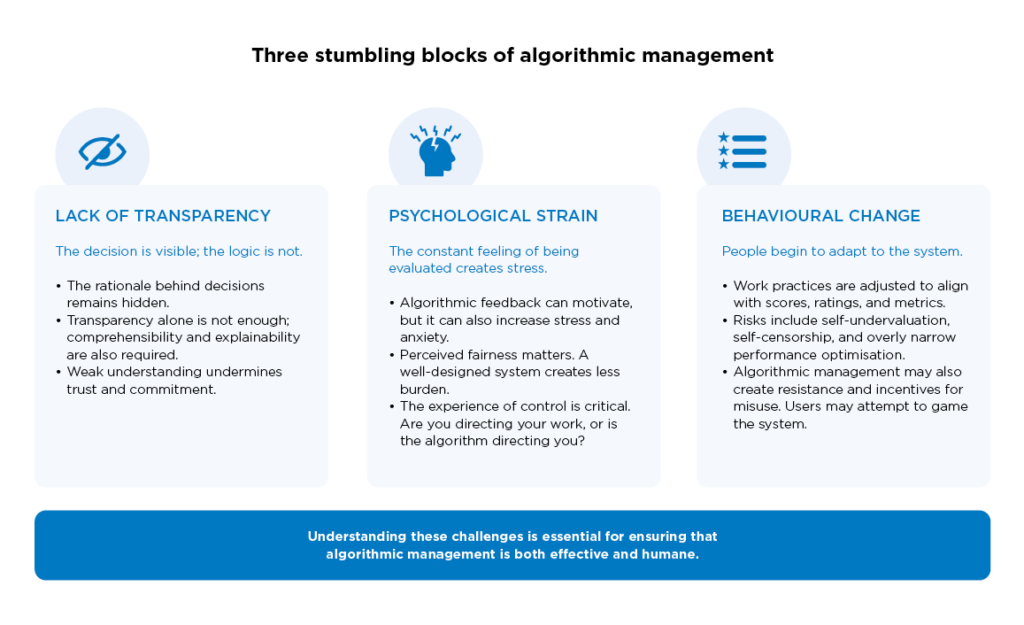
Figure 1. Three stumbling blocks of algorithmic management. View larger image.
In their article Seeing Without Knowing, Professors Mike Ananny and Kate Crawford17 from the University of Southern California provide an important distinction on this topic. According to them, seeing is not the same as understanding – you can be given access to an algorithm’s codebase, its weightings, and parameters, and still be completely confused about why, in your case, it arrived at that specific decision. Transparency without interpretation and context is like receiving a medical record from your doctor – but written in Latin. Amazon offers an often-used example of this: its systems have been documented, audited and, in many respects, thoroughly explained. Despite this, some Amazon employees have described their work environment as exceptionally closely monitored25-27. Already in 2019, researchers Alex Wood, Mark Graham, Vili Lehdonvirta, and Isis Hjorth demonstrated through a semi-structured interview study20that algorithmic management can simultaneously create a sense of autonomy and a sense of being controlled within the same system – and this double-edged nature is not necessarily dissipated through increased transparency.
From this perspective, the issue centres not only on transparency, but also on power – who has the right and opportunity to challenge decisions, who has access to data, and who is responsible when the algorithm makes a mistake. In an OECD survey published in 2025, nearly two out of three supervisors who utilise algorithmic management reported at least one concern about the reliability of the systems they used8. Their most common concern was related to the unclear question of liability in situations where an algorithmic system made an incorrect decision. When responsibility is distributed to a system, it does not disappear but becomes invisible. A manager can say that the system made the decision, but the system itself cannot defend itself or elaborate on the matter. In such cases, the employee is easily left entirely alone with a decision whose origin cannot be traced to anyone. This type of problem cannot be resolved by inspecting the system’s source code – it requires genuine human discussion.
When an employee receives a decision that they do not understand (e.g. a cancelled shift, a drop in their evaluation score, or the termination of their contract), they are not primarily looking for an explanation; they are looking for a person who will hear them out. It goes without saying that an algorithm cannot comprehend the issue like a human would: it cannot hesitate, apologise, feel sympathy, or change its mind. The algorithm is present everywhere at the data level, yet absent from the level where the human experience is formed. This can prove problematic, as management is fundamentally about interaction with people – various situations where two or more people must negotiate what is and is not fair, sensible, and effective. When the other party is replaced by an algorithmic system, the human party is left with fewer levels of negotiations and, in a worst-case scenario, only a decision that they must live with. For this reason, it is important to strike a balance between algorithmic and human management.
In essence, the question is one of how labour is consciously divided. Algorithmic management systems perform best in situations that feature an abundance of data and easily measurable criteria. Humans, on the other hand, excel when a situation requires interpretation, context, and empathy. The broader challenge most likely lies in the fact that organisations do not always make this distinction clearly enough. Or, alternatively, the decision is made under financial pressure and without anyone noticing or actually asking what they want the algorithm to do, why, and what it should never be allowed to do. However, we can expect awareness and practice to improve in the near future, not only because organisations have begun to understand the seriousness of the issue, but also because legislators have taken a stand on it.
3.1 AI literacy: an obligation and opportunity
The regulation of AI and algorithmic management is necessary, but it is unlikely to be sufficient for increasing understanding, creating a sense of security, or influencing how people behave. We need something that cannot be regulated from the outside: the ability to read the situation, interpret a system’s logic, and pose questions when something does not feel right. This is what we mean by AI literacy – not programming or the mathematical underpinnings of neural networks, but the collective ability to understand the basic principles of AI, use it responsibly, and identify the risks associated with it. This is important, because Finns still have a lot to learn here: according to a survey by KPMG (2025) 28, only 26% of Finns felt they had sufficient knowledge and skills to utilise AI.
Since 2025, AI literacy has evolved from a matter of good practice into a legal obligation for companies operating in the European Union. Article 4 of the EU’s Artificial Intelligence Act (2024/1689)24 requires the providers and users of AI systems to ensure that their personnel possess an adequate level of AI literacy. This represents a significant change from the previous situation, as it shifts responsibility from the individual to the organisation using the AI system, much in the same spirit as occupational safety legislation. In other words, it is no longer sufficient to simply provide a manual; employees need appropriate training and guidance to understand the potential opportunities, risks, and drawbacks of AI – not only for personnel and the company itself, but also for its customers and other stakeholders29,30.
AI literacy is not only a specialist technical skill or a superpower, but also a broader working life competence, representing a company’s collective ability to act safely with AI31. An essential part of this is that the obligation is role-sensitive: the Act’s literacy requirements vary depending on the role of the person using AI. From the perspective of algorithmic management, this gives rise to two practical competence needs. Supervisors are required to understand what kinds of decisions algorithmic systems make, on what basis, and what their limits are, so that they can supplement, question and, when necessary, ignore the system’s recommendations. Experts and knowledge workers, on the other hand, must have a sufficient understanding of how the algorithms that apply to them function so that they can assess their fairness and, when necessary, exercise their right to question decisions.
Herein lies the particular importance of AI literacy in algorithmic management: as noted previously, transparency alone is not enough – reading an algorithm’s code is of little use if it cannot be interpreted. Literacy is the bridge that transforms transparency into real understanding. Without it, an open system can be as difficult to understand as a closed one. So far, the Act does not very precisely define what sufficient literacy means in practice, as the details have been left to national legislation. Organisations that treat this requirement as a minimum obligation are likely to fulfil their duties without realising the opportunity it brings. Meanwhile, those who genuinely integrate AI literacy into their management culture – instead of treating it as a mandatory training day – can achieve something much more valuable: personnel who dare to ask what an algorithm does, for what purpose, and when its decisions should not be trusted. When utilised properly, algorithmic management can even improve the quality of working life32.
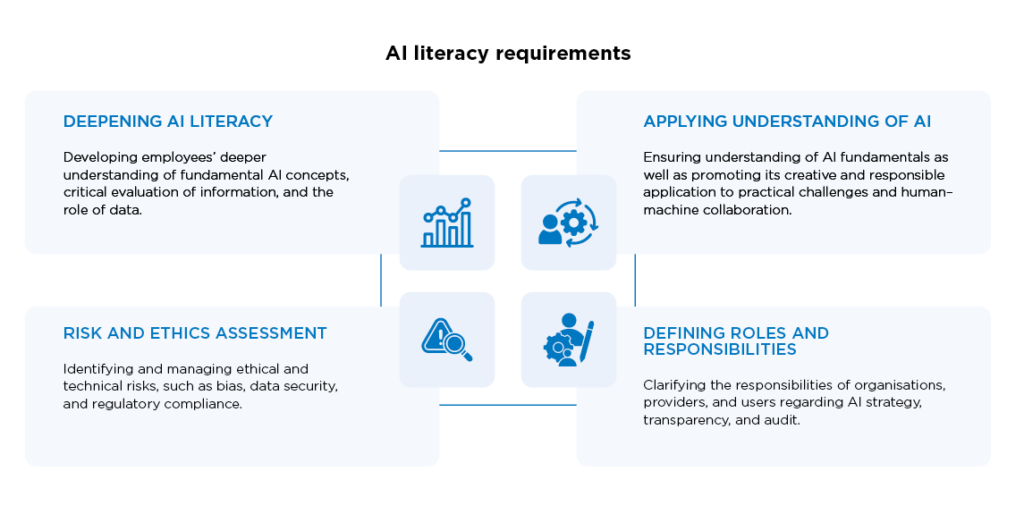
Figure 2. AI literacy requirements. View larger image.
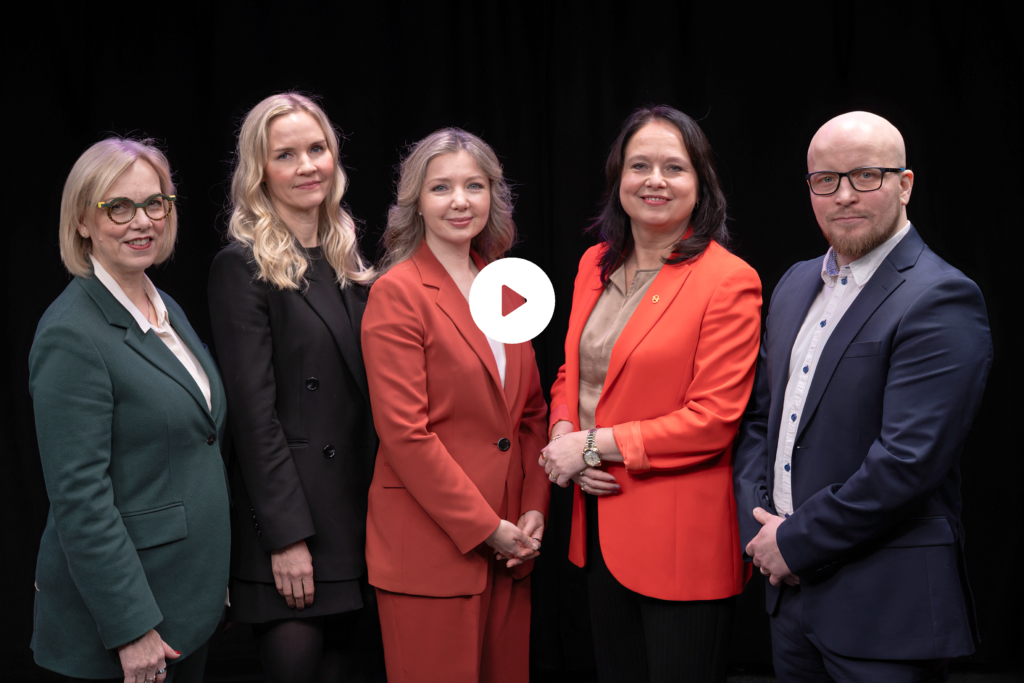
How can employees thrive under an AI boss?
in Finnish with English subtitles:
How does algorithmic management affect employee well-being? Could Nordic values serve as a model for more humane AI management? Panel participants: Aura Salla, MEP; Saara Hassinen, CEO of Technology Industries of Finland; Susanna Niinistö-Sivuranta, Managing Director of Finnish Education Employers at the time of the recording (thereafter Rector and Managing Director at Haaga-Helia University of Applied Sciences); Joonas Kevari, Lead Solution Consultant at Atea; and Anna Lahtinen, Senior Researcher at Haaga-Helia.
Live broadcast on Yle Areena on 19 November 2025.

Watch: The Good, the Bad and the Ugly of AI
in Finnish with English subtitles:
The discussion explores how artificial intelligence can free up time for care, education, human connection, and creative thinking, while also considering how to include those for whom the language of technology and economics feels unfamiliar.
Haaga-Helia’s stage program at SuomiAreena, 26 June 2026.
Read
in English:
AI as Sparring Partner, Not Replacement: Why Algorithms Can Be Fairer Managers Than Humans – Finnish AI Region
Cold but Fair? Algorithmic Management in the Workplace – Finnish AI Region

4. Algorithmic management in Finland today
Algorithmic management is still a relatively recent phenomenon in Finnish expert and knowledge-intensive work. The study we conducted between 2025 and 2026 provides the first comprehensive picture of how AI-driven management is perceived in Finnish workplaces, and the expectations, opportunities, and concerns associated with it.
In 2025, more than 1,700 knowledge workers and experts from different parts of Finland responded to our first national survey. 68% of respondents worked in expert roles, 23% in administrative positions, and 9% in management. The use of AI-based tools was already widespread: just over half of respondents reported using AI in their work at least once a week, while around one fifth did not use AI at all in their work. The second survey, aimed at managers and supervisors, was carried out in spring 2026, and we will present its results at the end of this chapter.
4.1 AI-based managers are already part of everyday working life
Nearly half of respondents reported having encountered a situation where a machine or AI had performed a task directly related to management. In practice, this meant that an AI had taken on a managerial role by monitoring the progress of objectives, proposing subsequent work stages, providing feedback, offering advice and encouragement, or supporting employees in problem situations. What makes these use cases interesting is that the role of AI extended from supporting individual work tasks to directing and evaluating the work itself.
Future expectations are likely to strengthen this trend – the majority of respondents believed that by 2030, AI-based management will be an established part of everyday Finnish working life. The increased prevalence of algorithmic management is seen as an almost inevitable part of the digitalisation and automation of work.
4.2 Human managers are still more popular than AI
Although people believe that algorithmic management is likely to become more common, their attitude towards AI-based managers remains cautious. Those employed in knowledge and expert work clearly favour human managers over AI ones, with the perceived quality of supervisory relationships being a particularly important factor. A good and confidential relationship with a human supervisor increases the distance between employees and AI-based managers while reinforcing the human supervisor’s status as a leader.
The trust employees place in their employer was identified as a key underlying factor. Respondents who felt that their organisation was reliable and fair felt more positively about algorithmic management, estimating that any changes would be either positive or limited in their impact. Correspondingly, weaker trust in the employer was reflected in more cautious attitudes towards AI management.
While respondents generally preferred human managers, AI-based managers were seen to have one clear advantage: they were perceived as more equitable managers than humans. This may be explained by the assumption that AI pays no heed to friendships, favouritism, or personal biases. Algorithmic management was viewed as being based on objective criteria that are applied equally to all employees.
4.3 How people feel about AI-based managers and the use of data
The attitudes that people have towards AI-based managers are explained by a number of factors. On average, those under the age of 40 responded more positively towards AI-based managers than older age groups. While we cannot change a person’s age, we can influence their attitude and willingness to experiment. Employees who are interested in technology and actively utilise AI feel that they are more ready to operate in environments where machines are involved in the management process.
A positive attitude towards AI is also reflected in the willingness to share one’s own work-related data with automated management systems. Like other AI-based systems, algorithmic management requires data to function. The more extensive and high-quality the available data, the better the system is able to support management. According to respondents, the most easily shared data are working time logs and breaks, competence and educational history, and the amount and quality of work. On the other hand, video recordings from workstations, audio and speech recordings, biometric identification, analysis of work email contents, and physiological well-being data were seen as non-negotiable limits. EU legislation also sets its own restrictions on algorithmic management and the related data collection practices.
4.4 Perceived impacts divide opinions
When assessing the effects of algorithmic management, the picture is twofold: around one third of respondents felt that algorithmic management eroded trust and loyalty towards the employer and undermined their experiences of long-term support and care. At the same time, many identified clear positive impacts, particularly in the clarity of workloads and working hours, the equal distribution of employment benefits, and the opportunities afforded for career-related development and progression.
In other words, algorithmic management is seen as a system that can simultaneously increase one’s experiences of fairness while also raising concerns about the human dimension of work.

“Can an AI-based manager be criticised? Who bears responsibility when a machine is left in charge? Everyone benefits when we can rely on AI to be correct and fair in management and support tasks – but we must also remember the risks involved, which is why we need legislative regulation. At best, regulation increases trust and transparency in the use of algorithmic management in organisations.”
Tuomas Meriniemi, Senior Specialist, Finnish Union for Professionals of Business and Technology
4.5 Participation determines acceptability
Being interested in technology also increases one’s willingness to participate in the selection of AI-based managers and planning their deployment. The highest level of willingness was reported in medium-sized organisations with 50–249 employees. At the same time, a small but significant proportion of respondents did not want to participate at all – their reasons varied from a lack of interest and feelings of distrust towards AI to the perception that their roles or schedules did not allow for their participation. Some also highlighted ethical concerns and the fear of losing their job. These observations emphasise that the acceptability of algorithmic management does not arise from technological solutions alone. The key question is how people can influence the systems that coordinate their work and how their role in this change will be perceived.
International studies also suggest that a lack of transparency in algorithmic management may significantly weaken a workplace’s atmosphere and employee trust in their employer and managers, which in turn may reduce individual commitment and work motivation 11,12. When we combine the results of our survey with international data, we see strong indications that algorithmic management is not a passing fad, but a structural change in the way we organise and coordinate work, which is why it is likely to become more prevalent in the future as these systems are developed further.
4.6 AI and human managers in expert work – a focus on management style and trust
While AI and algorithmic management are rapidly expanding into expert work, research on this phenomenon has so far focused primarily on the platform economy and manual labour (such as food couriers and warehouse work). We conducted a survey to determine how highly autonomous experts react to AI management, whether the technology itself can be distinguished from the management style it uses, and which individual management tasks provoked the most resistance among experts. We also examined whether positive relationships with human supervisors helped to mitigate the experienced effects of algorithmic management.
For this analysis, we selected the responses of 1,156 experts from our larger dataset and focused on scenario-based questions. In the scenarios, the experts assessed different work situations that varied by the type of manager (human or algorithm), management style (controlling, balanced, or flexible), and one of six management tasks ranging from monitoring and work scheduling to performance evaluation and employee support. To minimise the potential impact of biases, the respondents were randomly assigned a scenario that varied by manager type and management style.
The results demonstrated that management style was a far more significant factor than whether the manager was a human or an algorithm. Without exception, flexible management styles were preferred to controlling ones. Human managers were considered superior in tasks requiring interpersonal skills, judgment, and empathy, such as setting goals, evaluating performances, and providing support. By contrast, algorithms were widely accepted in routine and rule-based tasks. For example, in tightly controlled scheduling, algorithms were regarded as preferable to humans, as they were perceived as impartial actors that eliminated the risk of arbitrary decisions.
We also utilised statistical analysis to extensively map out how different background variables and attitudes influenced the evaluations. Surprisingly, the strongest predictors of approval of algorithmic management were the employee’s organisational trust and the quality of their existing supervisory relationship, rather than their technical skills or AI competence. Even though a high-quality relationship with a human manager effectively mitigated the negative experiences of a strict management style, this trust did not extend to algorithms. In other words, experts’ resistance to AI appears to stem primarily from the absence of human interaction rather than from a lack of understanding of the technology itself.
Based on these results, we can conclude that from a business perspective, algorithmic systems should be applied precisely on a task-by-task basis. AI is best suited for administrative, rule-based, and trackable routine tasks. In tasks requiring interaction and evaluation, algorithms should be limited to tools that support the human manager’s decision-making process. The successful integration of AI into expert work cannot be achieved through system training sessions alone – it requires safeguarding employee autonomy, participatory planning, and the continuous development of organisational trust.
4.7 AI in management – opinions from managers
We surveyed how Finnish managers perceived the role of AI in management and assistive tasks. Our survey received responses from 332 Finnish managers and supervisors, of which 323 were analysed after pre-processing. According to respondents, AI use is already commonplace: 74% used AI-based tools in their work at least once a week, while 35% used them daily or more frequently. Although managers expressed generally positive attitudes towards the new technology, they set clear boundaries regarding the types of decision-making in which they wanted AI to be involved in the future.
The views of these managers differed significantly when distinguishing between managing tasks and processes (“management”) and managing/leading people (“leadership”). Compared with humans, AI was believed to excel particularly in operational management: 57% of respondents felt that AI was stronger at analysing deviations, while 43% considered it more effective at optimising operations. Opinions were more reserved when it came to the capabilities of AI in leadership tasks. Although 30% believed that AI would be better at refining strategic directions, soft values were seen as an exclusively human domain: only 2% estimated that AI would be better at providing emotional support and empathy, and only 3% believed in the ability of AI to build trust.
These emphases are directly reflected in the characteristics of an ideal “AI-based manager”. Managers expect AI to be cognitively capable and logically consistent, but not human-like. The most important features of AI were the ability to adopt and utilise information (53% of respondents), its stability and ability to withstand pressure (52%), and its analytical thinking capabilities (51%). On the other hand, charisma (2%), social skills (3%), and empathetic interaction (4%) – the traditional domains of human managers – were seen as completely secondary characteristics. In other words, managers want AI to serve as an analytical advisor, without attempting to mimic human emotional intelligence.
Perhaps somewhat surprisingly, 58% of respondents felt that AI could be more equitable than humans in its management. This view was based on the perceived lack of subjectivity in AI: 87% of those who held this opinion justified it by stating that AI makes decisions purely on the basis of data, without considering personal relationships. In addition, 81% emphasised the absence of emotions and moods in AI decision-making, and 74% appreciated the consistency of its criteria. However, the drawback of this perceived objectivity is the absolute requirement for comprehensibility. Algorithms are expected to be transparent, as up to 83% of managers preferred a transparent AI with 75% accuracy over an unexplainable “black box” system that could achieve 95% accuracy.
Trust in AI decisions varies significantly depending on the use case. We asked managers whether they would be prepared to change their original assessments according to data-based recommendations offered by AI. Managers were the most willing to rely on AI recommendations over their own assessments in routine and purely data-driven situations, such as contract approvals (average level of trust: 55%) and the division of responsibilities in projects (50%). On the other hand, the lowest level of trust was reported in connection with decisions that require human judgment, such as choosing a new employee (33%).
A clear limit could be observed in the collection of data for AI-related purposes. Although most work communities approved measuring working time logs and the amount of work, managers were dismissive of any methods that strongly violated privacy: 79% of respondents stated that workstations should under no circumstances be subject to video surveillance for the use of management systems, while 61% were absolutely opposed to the use of audio and speech recordings. These results are similar to previous findings obtained from employees.
Read
in English:
An Algorithm as Boss? Nearly Half of Finns Have Already Experienced AI Management – Finnish AI Region
Algorithmic management spreads across Finnish workplaces – younger workers show greater acceptance than their older colleagues – Finnish AI Region
in Finnish:
AI Bosses Are Quietly Creeping into Workplaces – Helsingin Sanomat
“No Bias and No Favoritism” – AI Is Seen as a Fairer Leader Than Humans – Yle
An AI Boss Could Reduce Favoritism in Companies – Kauppalehti
Study Reveals: Finnish Employees Are Sceptical of AI Leaders – Tivi
A Machine Is a Fairer Boss Than a Human – Algorithm-Based Management Is Already Common, at Least in Medium-Sized Companies – TTT-journal
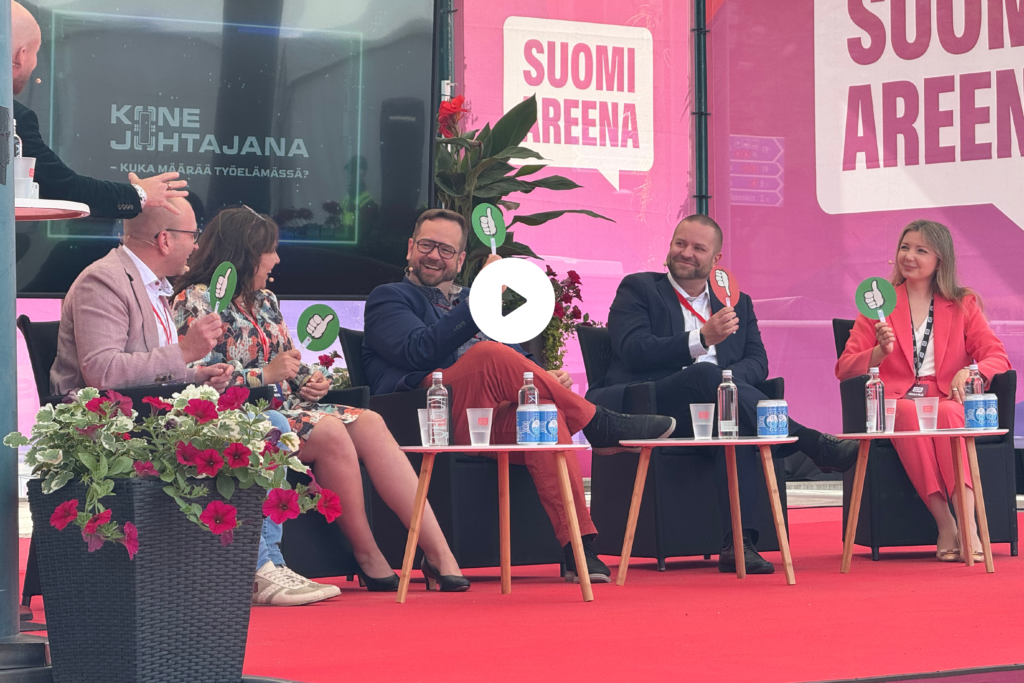
Machines as managers – who is making decisions in the workplace? SuomiAreena 2025
in Finnish with English subtitles:
AI is reshaping workplaces, but what happens when machines begin handling the tasks and decisions that have traditionally been the responsibility of human supervisors? How will this affect our experiences of trust, fairness, and the meaningfulness of work? Machine-assisted management evokes conflicting feelings, from enthusiasm to uncertainty, and we often do not realise how extensively it already influences our everyday lives. AI is used to coordinate and distribute work tasks, evaluate performances, and support the decision-making process – and, in some countries, even monitor workers.
In this SuomiAreena panel discussion, Haaga-Helia presents the results of its national RoboBoss study conducted in 2025, which examined Finns’ views and experiences of AI-based managers.
Haaga-Helia’s SuomiAreena panel, 27 June 2025.

5. How companies can gain added value from algorithmic management
“The same principles that govern business management and organisational change also apply to algorithmic management: you must first define your business processes and the desired changes, after which you can determine which technology best fits your business needs. Agents are not managed via individual prompts, but through a target architecture shaped by your business objectives. The key part of this architectural process is maintaining a continuously adaptable enterprise architecture, which necessitates continuous collaboration between business and IT. The target architecture is built on a strong strategy with clearly defined goals. For this reason, organisations should use clearly defined qualitative indicators in addition to quantitative indicators.”
Joonas Kevari, Lead Solution Architect, Digia
“Managing a micro-enterprise is a close-knit process where every recruitment or change in work divisions becomes a critically important choice. Indeed, the greatest promise of algorithmic management is that it can bring more objectivity and transparency to smaller work communities. When machines can assist with process optimisation and knowledge-based management, entrepreneurs can focus on fostering their corporate culture and ensuring that growth is managed in a humanely sustainable manner.”
Petri Ovaska, Regional Director, Uusimaa Entrepreneurs (Regional Association of the Federation of Finnish Enterprises)
What does algorithmic management mean at the corporate level in Finland? And how should algorithmic management be implemented in Finnish expert organisations? We began looking for answers in a series of company-specific workshops. The aim of the workshops was to deepen the material from the project’s other research stages and to contextualise our results within the framework of Finnish expert work. We also aimed to implement the insights we had gained during the project into the everyday culture of the companies that had co-financed the project.

The workshops were carried out in spring 2026, and in four out of five workshops we used the Lego Serious Play (LSP) method, where participants build the answers to the workshop facilitator’s questions using Lego bricks, either alone or in small groups. The facilitator is a person who has been certified in this method. A key element of the process is the verbal explanation of the Lego models to the other participants and the discussion that emerges from this. Studies have found that the LSP method is particularly effective in research that focuses on abstract, difficult-to-comprehend topics, such as AI and desirable futures33,34. The LSP method has been successfully used by a number of internationally renowned companies, such as Microsoft, Google, IBM, and The Coca-Cola Company.
The main idea behind the LSP workshop is to express ideas using Lego bricks and, as in brainstorming more generally, there are no right or wrong answers. The workshop is also not a contest to build the most beautiful or realistic Lego model; rather, its purpose is to explore the significance and symbolic meaning that each brick holds for the model’s builder at that particular moment. Lego bricks can be used to describe complex thought patterns and various processes, for example through their colours, shapes, or the order in which they are arranged. The workshops require no advance preparation, and participation does not require any previous experience in Lego or the LSP method.
The selection of the workshop method was based on the characteristic way in which the LSP method encourages participants to think through their hands and make abstract ideas more concrete. When participants are asked to build models, they have to clarify their thoughts and express them to others in a visible form, using their own words. Some have playfully described the method as 3D printing one’s own thoughts. In practice, the method flattens hierarchies, as each participant is provided with the same tools. In many cases, each participant also receives the same Lego bricks – and everyone is given an equal opportunity to speak.
Lego structures can also help people safely discuss difficult topics, as the focus is on the model instead of the person. Studies have shown that play increases creativity, but the workshop-like structure still keeps the work goal-oriented. Play allows people to take risks and try different roles that differ from their usual lives. Building together strengthens listening, inclusion and the formation of lasting memories, while encouraging a shared language for complex phenomena, helping to make the invisible visible and supporting organisational decision-making.
How does the LSP method work?
Lego Serious Play is not just a fun exercise, but also a powerful tool for bringing out the types of knowledge and understanding that traditional methods cannot reach. In practice, the workshops follow a relatively simple routine: the facilitator assigns the participants a task that prompts them to reflect on the topic from their personal perspective and express their thoughts in the form of a Lego structure.
The participants then construct their models from the Lego bricks, either in silence or through group discussion. The most important point is to give each person space to think and develop a deeper connection to their own insights, without any external distractions. Then, each participant takes turns to explain what they have built and why, describing the significance of the different parts of the structure and their links to personal experiences. These reflections are then contextualised and summarised with the facilitator’s support, allowing the individual models and stories to form a shared understanding of the topic and its significance for the entire work community.
The workshop is facilitated by a certified LSP facilitator, typically lasting from 2 to 4 hours. During the workshop, the Lego models are photographed for documentation purposes, and the participants’ descriptions of their models and the resulting shared, focus group-type discussions are recorded for later analysis, in order to maximise the benefits of the workshop.
The LSP method has a long history – over the past 20 years, it has been used in a versatile manner for numerous purposes, such as teamwork, problem solving, scenario work, and futures research.
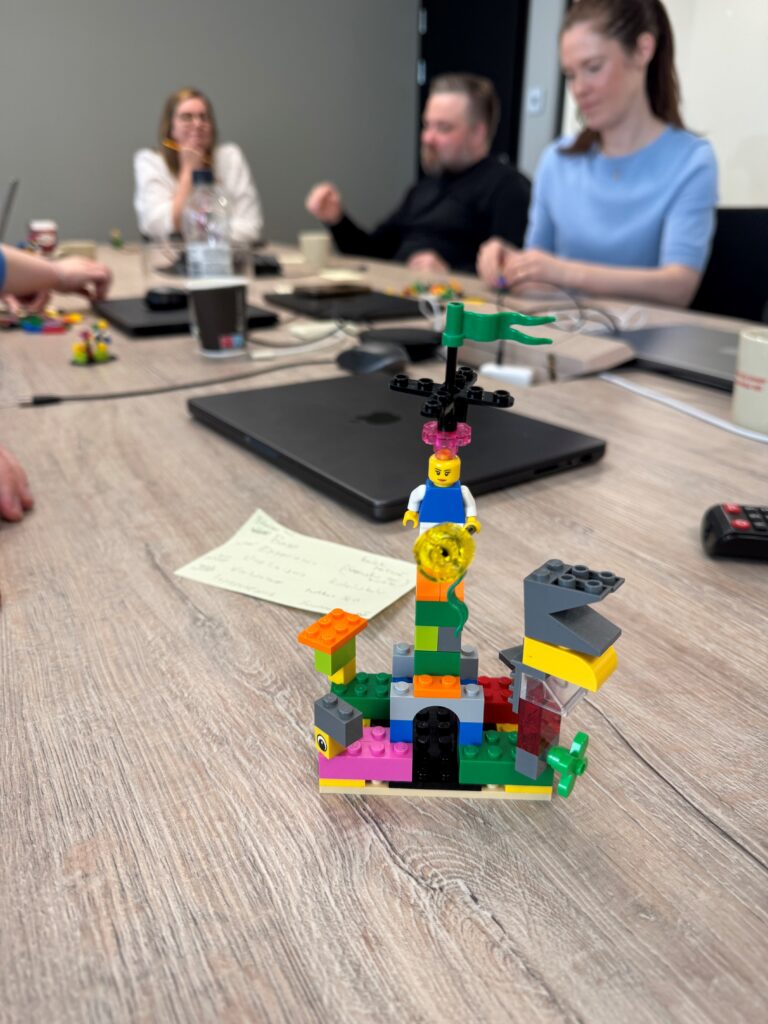
AI as a Boss research: LEGO Serious Play workshop at Sympa, spring 2026.
5.1 Use cases for AI in management processes
Throughout the “RoboBoss – AI in the Leadership of Knowledge Work and Expert Roles” project, we have paid close attention to the analyses by Kellogg, Valentine and Christin10 as well as Parent-Rocheleau and Parker11 on algorithmic management. According to their conceptualisations, algorithmic management can be understood as a system where algorithms participate in the coordination, monitoring, evaluation, scheduling, rewarding and/or sanctions against employees. Kellogg et al.’s10 analysis of algorithmic management places particular focus on the mechanisms that enable control. According to them, algorithms can limit the ability of employees to act, provide recommendations on how to perform work tasks, record and monitor employee activities, evaluate performances through scoring or ratings, reward desired activities, and replace or exclude employees from work tasks.
Parent-Rocheleau and Parker11, on the other hand, structure algorithmic management from the perspective of management activities. According to them, algorithms can, for example, handle monitoring, goal setting, performance management, scheduling, compensation, and job termination. By combining these perspectives, algorithmic management can be seen as an entity in which technological systems not only support supervisory work but can also make or communicate management decisions that affect employees.
In addition to these type classifications of algorithmic management identified in previous research literature, we have also proposed a new classification in our project: algorithmic management in the context of coaching leadership. In our view, coaching leadership in the context of algorithmic management could be used to emphasise dialogue, learning, and a human-centred approach in work tasks coordinated by technology. When algorithms are used to produce recommendations, indicators, and decisions, managers must increasingly support their employees’ understanding, autonomy, and ability to think critically. The (human or algorithmic) coaching leader ensures that data is used transparently, ethically, and in a manner that supports employee development and professional growth.
Based on this theoretical framework, the RoboBoss project’s LSP workshops investigated the participants’ personal strengths in the era of AI, identified pain points related to management processes, and considered how AI could be used to facilitate different management processes. In addition to concrete AI use cases, the participants reflected on the factors that enable companies to become AI frontrunners: what conditions must be in place for a specific organisation to act as a pioneer in human-centred algorithmic management by 2028? What objectives, sub-objectives, processes, threshold conditions, and risk management systems would support a pioneering approach? What resources – such as competence, time, and money – do pioneers need? And what must be sacrificed to make these “necessary” strategic choices for pioneering work, i.e. what is left undone or given less attention when focusing on human-centred algorithmic management?
Several of the workshops also highlighted the use of AI as part of resourcing: especially at the start of projects, but also proactively during them. The participants’ ideas included an AI delegator that would identify peaks in individual employee workloads and proactively distribute tasks to other colleagues with similar skills. The role of AI as a competence mapper was also a key idea; for example, an AI bot that could arrange half-hour sparring discussion with all employees and based on these, create personal competence profiles.
Partly in connection with the theoretical vision, we had developed of algorithmic management as a component of coaching leadership, the workshops also explored the idea of a job rotation robot, i.e. an AI tool capable of identifying and proposing job rotation arrangements at different levels of an organisation. In connection with the same topic, the possibility of using AI as a tool for capturing tacit knowledge also emerged: when solving a complex problem, a more experienced employee could verbalise their solution to AI for context, and the AI could later help less experienced employees get started in similar situations.
All in all, the workshop participants brainstormed a huge number of different use cases for AI, where an AI-based manager could act as a scheduler, monitor the achievement of goals, and provide general reminders to employees. To a lesser extent, the workshops also highlighted the use of AI in setting goals and evaluating performances, although these were often for very case-specific and clearly defined use cases. In the context of expert work, participants did not yet see a role for AI in decisions related to rewards, reprimands, warnings, or the termination of employment.
5.2 At best, algorithmic management can support people
Our dream at Foibekartano is to enhance our algorithmic management so that it can help our personnel to develop both their work and themselves. We do not see algorithmic management as a technical solution, but as a way of highlighting everyday issues and making management more knowledge based.
We want to create added value by providing more information that will help us react more quickly, allocate resources more wisely, and support our supervisors in situations involving multiple variables. At best, this is reflected in increased efficiency, financial sustainability, perceived fairness among our personnel, and the improved lives of our residents.
The Lego Serious Play research and development method demonstrated that doing things by hand is a good way of thinking about the future together. At first, we were not sure what we were aiming for, but our ideas gradually began to take shape as we continued building. The method helped us get started in an open-ended situation and vividly visualise thoughts that would have been difficult to verbalise through discussion alone. The resulting models described our future AI needs and depicted the type of support that is needed in our everyday management. At the same time, the process itself was a fun and insightful experience that made everyone feel successful. It was particularly valuable to have supervisors from every Foibekartano house participate in the process – this allowed us to examine our future needs not only from a singular perspective, but also from the everyday perspective of our entire community.
AI-based work schedule planning is already an important part of our knowledge-based management. Whenever there is a change in our customer headcount, the ability to rapidly adjust our staffing ratio has been significant for both our operations and finances. AI has allowed us to account for complex dependencies more efficiently than if we had handled it manually. At the same time, everyone feels that our work schedule planning has become more equitable than before, which has also been reflected in our personnel satisfaction surveys.
In the future, we hope that AI can also support our customer documentation process. It could remind and guide us to document matters that are essential for supporting our residents, looking after their well-being, and monitoring their everyday lives. At the same time, AI could strengthen the quality of our documentation and help our documenters constantly improve.
From a management perspective, it would also be important to better highlight whether our working hours are focused on matters that truly improve our residents’ everyday lives. This also involves quantitative and qualitative data on pressure ulcers, which represents a concrete example of how the quality of our residential care can produce important information for our management processes. At best, this information can help us identify risks in time, strengthen our foresight, and support a good quality of life for our residents.
Ulla Broms, Managing Director, Foibekartano
Read

6. Algorithmic management as part of the AI debate: hype, pressure, and judgment
Thematically, algorithmic management is broadly linked to the wider debate about AI, even though it does not always necessarily rely on AI. However, it is worthwhile to discuss the features that reflect the current state and future direction of algorithmic management, as well as the broader digital transformation, as these are characteristic of this particular period. In 2026, AI is sure to be on the agenda of a large number of organisations. The news continuously discusses the different impacts of AI on workplaces and society, with the overarching theme seemingly being that the world is changing rapidly.
While the current technological change may seem exceptionally significant, it is still worth considering whether this is truly the case or whether it is an example of what researchers call recency bias. Recency bias refers to the human tendency of giving disproportionate weight to recent experiences, making the latest change feel more permanent and significant than what long-term developments would suggest. This is why, for example, a recently experienced technological, political, or personal change may seem exceptionally significant, even if there have been similar or even greater changes in history. In other words, recency bias can distort a person’s ability to assess where the world is going, as fresh experiences remain vividly in our memory while any older comparison points seem far off in the distance.
As a special feature of the AI era, algorithmic management is subject to new forms of pressure linked to both the rapid pace of technological change and the dominant narratives surrounding AI. While digitalisation has long shaped the activities of organisations, the development of generative AI and the platforms that support it is seemingly progressing at an exceptionally quick rate, creating a form of FOMO (fear of missing out) in organisations concerned that their competitors may reap the benefits of AI first.
From the perspective of algorithmic management, this raises a key question: is the automation of management based on prudent, data-driven, and responsible decision-making, or is it being guided by technological narratives that advocate delegating managerial tasks to algorithms on the assumption that AI systems are faster, more comprehensive in their use of data, and therefore “more knowledgeable”? A particularly important point is that algorithmic management is not merely one AI application among a wider set of AI tools, as it sits at the core of an organisation’s activities: how work is directed, evaluated, coordinated, and controlled.
At the same time, the wide availability of AI tools has blurred the traditional understanding of the centralised nature of management. When employees are given their own AI assistants, such as Copilot or Claude Cowork, algorithmic management may no longer be understood solely as top-down control, but also as self-directed AI assistance for everyday tasks and self-management. This may become emphasised especially in expert and knowledge-intensive work, which already relies on the person’s ability to independently organise their work. In this case, the essential question is who or what is actually managing the work: a human, the organisation, the employee’s own AI assistant, or a technological platform operating in the background? In addition, if the generative AI system has been programmed to flatter its user or confirm their assumptions, it can produce a distorted understanding of the situation and complicate the type of assessment vital to management. This is why, in the context of algorithmic management, it is necessary to carefully assess what level of access AI systems should have to data on employees, performances, and decision-making, as well as where this access should be limited.
The risk of vendor lock-in within AI ecosystems also makes algorithmic management a strategic and institutional issue. If the algorithmic solutions to management are increasingly built on platforms already extensively integrated into organisations and on the ecosystems of large technology vendors, the situation is no longer that of a single tool procurement, but the possible technological redefinition of the organisation’s entire management system. In this case, it is appropriate to ask to what extent management will remain an internal function of the organisation and to what extent it will be outsourced to the operational logic, terms of use, data structures, and optimisation principles of external platforms.
Uncertainties related to information security and regulation can also hold back experiments, even if some of the risks are later normalised in the same way as with previous digital tools. From the perspective of algorithmic management, this means that organisations must be able to distinguish between genuine issues of information management, responsibility and privacy, and a more general caution driven by the novelty of the technology. Algorithmic management is not an individual tool that can be implemented through a separate procurement – it is a decision about how an organisation wants to manage itself, and therefore also requires a clear strategic foundation.
In practice, this means that before an organisation assigns algorithms a role in its management tasks, it should be able to answer a few fundamental questions: Which management tasks will the algorithms be used in and why? Whose values and conditions will direct the algorithms? Who is responsible for the decisions made by the systems? And, just as importantly, which tasks will not be handled by the algorithms?
There are no universal answers to these questions, but they still need to be asked – preferably before rather than after the deployment process. Without this foundation, algorithmic management can easily lead to a situation where the technology shapes the organisation’s management culture, rather than using the organisation’s culture and objectives to guide technological choices. It has been repeatedly pointed out on various occasions that these questions are often left unanswered. Typically, organisations select their systems on the basis of hype or specific needs, but without the help of desired guidelines or visions, even though a comprehensive AI strategy is not an obstacle to the introduction of algorithmic management. On the contrary, it can help ensure that the roll-out process will result in more than just additional costs and resistance to change.
Perhaps the key point is to avoid a technology-driven approach. Algorithmic management is a recent, compelling, and highly engaging phenomenon, but this is precisely why its implementation should be assessed particularly critically. As with the wider utilisation of AI, the starting point should not be on merely being a pioneer, but on developing a clear understanding of the problem to be solved, the desired value, and the acceptable consequences. Otherwise, there is a risk that organisations will focus on appearing AI-competent while ignoring essential questions related to management, work quality, trust, and responsibility.
Read
When Algorithms Take the Reins: How Digital Management is Reshaping the Future of Work
– Finnish AI Region
How (Not) to Destroy Your Business with AI – Finnish AI Region
The Problem Is the AI Strategy — or Rather, the Lack of One – Finnish AI Region
in Finnish:

7. Implications for organisations: the roots, blooms, and thorns of algorithmic management
The findings of our research can be summarised in the form of a rose: the roots, blooms, and thorns of algorithmic management in Finnish expert and knowledge work. Blooms describe the visible added value that makes algorithmic management attractive. Roots form the basis for sustainable benefits. Thorns, on the other hand, represent tensions, pain points, and risks.
Few people admire roses because of their roots or thorns, but without them, a rose could never bloom. The same applies to algorithmic management: sustainable benefits can only arise if it is managed in a long-term, systematic, and humane manner.

“The debate on algorithmic management all too often turns to risks, tacitly transforming our current state of affairs into a reference point that seemingly trumps any new additions to it. This is particularly emphasised in ethical assessments, which tend to focus on adverse effects.
However, we need to broaden our perspective. Algorithmic management should be approached primarily through opportunities while simultaneously examining its benefits and risks. It is only on this basis that we can make conscious choices that are useful, effective, and responsible at the same time.”
Niklas Bergström, Vice President HR Operations, Kesko
7.1 Roots: values, trust, competence, and data
The roots form the foundation. Without strong roots, algorithmic management cannot produce any blooms, only more thorns.
The success of algorithmic management is primarily built on trust. Trust and a good relationship with one’s employer, whether technology is seen as a supportive force, and how significant the introduction of algorithmic management is considered in the workplace. This is reinforced by experiences of inclusion: the opportunity to influence, understand, and participate in how algorithms are used. The introduction of AI and algorithmic management into the work community also requires employees to commit to the workplace, its bold experiments with technology, and its future visions.
Communality and genuine inclusion practices are central to this process. If the employees of an organisation feel that they are involved in shaping the change, their commitment is strengthened. At the same time, algorithmic management can help highlight differences in commitment and force organisations to examine who is included and who is excluded.
Another key foundation is competence and attitude. A technology-positive attitude alone is not enough; organisations need active experience in AI. This requires continuous learning from both individuals and organisations.
Reliable use is also based on clear rules. Employees must know what data is collected, for what purpose, and who is responsible for the AI-based manager’s decisions. Blurred accountability quickly deteriorates trust.
Finally, roots are also ethical and cultural. Psychological safety, empathy, and human interaction, as well as regulation that protects people, determine the shape of algorithmic management in everyday life.
The roots form the foundation:

- Employees’ trust in their employer and commitment to the workplace
- Employees’ sense of participation and influence, as well as a positive attitude toward technology and the skills to use it effectively
- Clear workplace policies regarding what data is collected and why
- A shared understanding within the workplace of how algorithms are used and who is responsible for decisions made by the system
- Leadership that emphasises empathy and human interaction, employees’ psychological safety, and the ability to combine data with human judgment
- Human-centred legislation that both supports and sets boundaries for the use of algorithmic management
7.2 Thorns: tensions that must be managed
Thorns represent risks, pain points, and experiences of dehumanisation.
Algorithmic management inevitably involves tensions that emerge especially in everyday experiences.
A key risk is the erosion of trust. If there is insufficient transparency or a cursory level of inclusion, employees may come to feel that their organisation is not acting in their interests. At worst, this may manifest as experiences of short-sighted optimisation and indifference.
Concerns about the biases, errors and logical incomprehensibility of AI can weaken psychological safety.
Another equally significant tension is linked to liability and judgment. When decisions are transferred to algorithms, is human judgment retained, and who is ultimately responsible? This is linked to the wider uncertainty about the role of supervisors: what is the division of labour between humans and algorithms, and can management and leadership be genuinely automated?
The transitional phase will only highlight these tensions. Resistance to change, hype around new technology, and the fear of being replaced often occur simultaneously. Organisations can act hastily and move faster than their culture and competence allow. At this stage, it is important to emphasise patience and realism: the role of supervisors cannot be dismantled until new practices function reliably.
Thorns represent tensions, risks and pain points:

- Superficial inclusion efforts by employers and a lack of transparency
- The threat of weakening employee trust and loyalty
- Employees’ perception that their employer does not genuinely care in the long term
- Increased workload and efficiency pressure caused by new systems and continuous data monitoring
- Employees’ concerns about excessive surveillance, incorrect data interpretation, and errors made by AI-driven management systems
- Employees’ concerns about the lack of individual judgment and the outsourcing of responsibility
- Blurred accountability, transparency, and fairness in algorithmic decision-making
- The weakening of humanity, empathy, and psychological safety in management
- Tensions between efficiency, privacy, ethics, and competitiveness
- “Speed blindness” – rushing ahead without critical reflection – leading to resistance to change when hype is intense and many fear being left behind
- The growing perception that employees and supervisors are replaceable
- During the pilot phase, the AI-based manager will make mistakes – this requires patience and preparation for a transition period
7.3 Blooms: tangible benefits
The allure of algorithmic management is based on its added value. The clearest benefit is related to efficiency: the routine processes of supervisors can be automated, freeing up time for tasks that require human presence and judgment. Especially in supervisory work, this can result in more time for human interaction.
Another key benefit is the systematic nature of the decision-making process. Algorithms can reduce human biases and strengthen experiences of fairness, as AI-based managers do not play favourites or hold personal biases toward individuals. This can be reflected in, for example, more evenly distributed workloads, predictable working hours, and transparent resource allocation.
Algorithmic management can also help harmonise practices. The allocation of shifts, workloads, and employee benefits can become more consistent, reducing ambiguities and perceived unfairness.
At best, data can be used to support individual development. It can help identify strengths and areas of development more systematically and provide career opportunities in a way that is not just based on visibility or personal preferences.
Blooms represent the reasons why organisations become interested in algorithmic management:

- Improving efficiency in routine supervisory processes and achieving time savings
- Automating reporting, documentation, and other administrative tasks
- Increasing the meaningfulness of work by freeing supervisors’ time for human interaction
- A stronger employee experience of equality and objectivity
- Reducing human error
- Clearer workloads and working hours
- Improved work forecasting and allocation of work tasks
- More consistent implementation of employment benefits and practices
- Understanding complex operational environments and combining multiple data sources to support management
- Earlier identification of workload issues, risks, and well-being challenges
- Supporting executive decision-making and strengthening critical thinking

8. Workplace recommendations
The introduction of algorithmic management is not only about acquiring new technology, but also about how it will change work coordination, responsibility, trust, and interaction between people in the organisation. The following recommendations bring together the observations made from the project’s research data for work communities. They offer questions and perspectives that should be considered when AI begins taking part in your organisation’s management.
1. Pay attention to when AI changes from a tool into a manager
- Not all uses of AI in the workplace constitute algorithmic management. Algorithmic management occurs when a system begins to influence work coordination, monitoring, scheduling, task allocation, goal setting, feedback, evaluation, rewarding, or the employees’ ability to act. Organisations should identify these items separately, as their impacts on responsibility, trust, and employee autonomy are greater than in ordinary AI-assisted work, where employees are still in control.
2. Define the role of AI one use case at a time: background information, recommendation, coordination, or decision?
- The key to algorithmic management is not only what the system does at a technical level, but also what influence its outputs will have. There are clear differences between using AI to generate reports for supervisors, propose subsequent work tasks, automatically adjust work shifts, or influence employee evaluations. For each use case, it is important to define whether the role of AI is passive, advisory, directive, or participatory in decision-making.
3. Assess the suitability of AI one management task at a time
- Algorithms are more easily accepted in tasks that are rule-based, recurring, and data-oriented. These include scheduling, visualising workloads, reporting, giving reminders, project progress monitoring, and preliminary resource coordination. On the other hand, goal setting, performance evaluation, feedback, recruiting, rewarding, and difficult personnel situations require special judgment and human participation. Some management tasks are not the exclusive domain of either humans or AI. For example, resourcing, competence assessment, indicator setting, recruitment support, reward allocation, and workload assessment involve both data-driven analysis and human judgment that directly affects people.
4. Humans should be responsible for human interaction
- When you let algorithms take control of routines, reporting, and monitoring, the relative value of human interaction only increases. Holding difficult discussions, giving encouragement, building trust, and dealing with conflicts should remain the domain of humans, and AI should not be used to outsource uncomfortable management situations to digital systems. A good starting point is that an algorithm can identify and highlight strain points, deviations, or situations requiring intervention, but a human should assess the situation and bear responsibility. The supervisor’s ability to listen, provide meaning, and manage difficult situations will be a key competence area in future management, and it should be prioritised in training and recruitment.
5. Pay attention to management styles, not just technology
- In our research, experts reacted strongly to the type of management style a system used. An opaque algorithm that relies on a controlling style and minute instructions easily provokes resistance, even if its purpose is to increase efficiency. An algorithm that is flexible, respects autonomy, and supports employees is more likely to be accepted, especially in expert and knowledge-intensive work. A good organisational culture or trust in a human supervisor is not automatically transferrable to an algorithm, as it needs to build its own foundation of trust.
6. Involve personnel through concrete use cases
- For many, algorithmic management is a topic that is both abstract and difficult to understand, so discussing AI in general terms will not necessarily help people form their own opinions. It is a better idea to link these discussions to concrete situations: could AI help allocate work tasks, propose training opportunities, monitor workloads, evaluate performances, or alert supervisors to issues that require discussion? You can also use this opportunity to identify the boundaries that your work community does not want to cross.
7. Highlight the data used in algorithmic management and why it is used
- Algorithmic management is based on data, but not all work data is acceptable, necessary, or lawful for algorithmic use. Working time, competence, and project data differ in nature from video, audio, email content, browsing histories, location data, or physiological data related to well-being. The key question is not only “can we collect this data?”, but also “is its use for management purposes necessary, proportionate, and understandable from our employees’ perspective?”
8. Favour explainability, especially when a system impacts people
- An algorithm that is used in management does not always have to be fully open in a technical sense (e.g. neural networks), but its effects must be understandable. Employees and supervisors should know what its recommendations, alerts, scores, and priorities are based on. The more impact the system has on the status, evaluation, job opportunities, or career development of employees, the more important it is to favour explainable solutions over black boxes.
9. Pay attention to how indicators may change work
- Algorithmic management makes measurement more continuous, precise, and visible than before, but its indicators do not only describe work – they also shape and direct it. If a system optimises for speed, response time, billable hours, or number of performances, employees may begin to adapt to these metrics at the expense of quality, learning, collaboration, or creativity. For this reason, you should assess what kinds of behaviours algorithmic management indicators may strengthen in your organisation.
10. Remember the principle of least access in algorithmic management
- It is not advisable to give an AI system full access to all your organisation’s data just because it is technically possible. The algorithm should only access the data sources and functions that it needs for its predefined management task. The same applies to human actors: if the system generates evaluations, alerts, or recommendations related to specific employees, you need to determine who may access whose information and on what basis.
11. Define the division of responsibilities in algorithmic management
- Algorithmic management changes how we coordinate, wield power, and act responsibly at work, so it should not be considered the sole domain of IT, HR, individual AI-enthusiast developers, or software vendors. The process requires the participation of the organisation’s management, HR, IT, legal experts, supervisors, and personnel representatives. The more the system affects the status, evaluation, or everyday lives of employees, the more important it is to establish a clear division of responsibilities and a shared management model.
12. Prepare for additional work, errors, and an extended transition period at the outset
- The introduction of algorithmic management can be a significant change in workplaces with long-established approaches to work. The early stage of the process may be characterised by false alerts, recommendations based on incomplete data, unclear responsibilities, additional investigative work, and seemingly unfair interpretations. Your organisation should consider in advance how it will detect errors, how these will be communicated, who will correct them, and how employees will be permitted to question algorithmic decisions that concern them.
13. Focus on long-term productivity, not just individual employee efficiency
- The benefits of algorithmic management will not necessarily be immediately reflected in a faster pace of work or reduced personnel costs. The deployment process may initially increase your costs, training needs, integration issues, and new invisible work: the system must be trained, monitored, corrected, and explained. It is important to assess your productivity more broadly – whether there are improvements in work efficiency, decision-making quality, resource allocation, workload forecasting, and competence utilisation, and whether your supervisors are better able to focus on human interaction.
14. Identify dependencies on technology vendors
- Like other IT systems, algorithmic management systems are often built on the ecosystems of major technology vendors. This can create a long-term vendor lock-in scenario in which the updates, pricing, or policies of an individual supplier begin to influence how an organisation is managed. It is important to assess in advance how easily a system can be replaced, who has ownership of the related data and models, and how you can prepare for a situation where your supplier’s solutions no longer meet your organisation’s values or needs.

9. The future of algorithmic management
This chapter is based on the foresight study carried out by the RoboBoss project in autumn 2025. The study was carried out using the Delphi method, and its purpose was to define the possible futures of algorithmic management in expert and knowledge-intensive work. Experts in strategic management and supervisory work from different sectors of Finnish working life were invited to the Delphi panel. The Delphi panel’s future scenario statements were set in 2035. The panel’s aim was not to reach a consensus, but to explore the future of algorithmic management through dialogical, divergent, and opposite perspectives, in accordance with the argumentative Delphi tradition35.
This chapter first examines algorithmic management in strategic management and then in supervisory work. The latter part of the chapter describes which tasks will be handled by algorithms in the future and which will remain within the domain of human managers, based on the Delphi study. Finally, the chapter presents the management competencies required in the era of algorithmic management and concludes with a summary of the chapter’s contents.
9.1 Algorithmic management in strategic management
Will AI become a voting member of corporate boards in the future? Will AI be allowed to make independent decisions within management teams? Will future CEOs have digital twins who can be on call when the human CEO is asleep? Will future managers manage flocks of AI agents?
The future of algorithmic management is often easy to view as a linear development path. In any case, the rapid advancement of AI technology has accelerated organisations’ efforts to harness its promised efficiency gains, which is why the use of AI in management may seem like a natural development and the next logical step.
According to our Delphi panel, however, the future of strategic management is not so straightforward, as they identified three alternative but plausible future scenarios. These options are presented in Table 1 as the threatening, moderate, and techno-optimistic future.
According to the first option, AI may become a threat to strategic management (see Table 1) if it is allowed to make independent decisions. This vision of the future is based on the idea that algorithms cannot comprehend complex situations and long-term impact mechanisms, relationships between people, or ethical tensions. In similar but complex situations, AI may come up with different solutions at different times, which is why allowing AI to make independent decisions may pose a risk to organisations.
Another significant risk is related to blurred accountability. If strategic decisions are delegated to AI, or an AI “clone” is used to substitute for an organisation’s CEO, it becomes unclear who will be responsible for any errors they make. An algorithm cannot meaningfully bear responsibility, but humans also cannot fully inspect how an AI arrived at its decision. Even if significant strategic efficiency gains could be achieved at the organisational level through the radical replacement of human labour with AI agents, the resulting mass unemployment would threaten the entire market economy, as people would lose both their jobs and their ability to purchase goods and services offered by other companies.
In the moderate vision for the future (see Table 1), AI will assume a clearly supportive role in strategic management, acting as an “assistant” or “support staff” to the management team or board. In this vision of the future, AI strengthens decision-making but does not replace human judgment or the responsibility of management. AI collects and analyses information, identifies trends, and offers alternative perspectives to support strategic decision-making, and, in some cases, can also function as a substitute for a strategy consultant. Despite this, an accountable manager is expected to make any final decisions and assume responsibility for them. The core of the decision-making process remains human, even as its analyses are augmented with technology. The manager combines the information produced by the algorithm with their own experiences and the history and values of their organisation.
In the techno-optimistic future (see Table 1), part of strategic management is automated in a controlled manner. In this vision for the future, strategic decisions are based on analyses and solution proposals produced by an AI trained within the organisation. This enables the integration of diverse data sources, forecasting models, and evaluation frameworks in a far more comprehensive manner than is typically possible in traditional strategy work. AI is able to identify weak signals and create alternative future scenarios. The strategy becomes a continuous, data-driven process where AI can replace the role of a junior-level strategy consultant. This option leverages the efficiency gains offered by AI agents in a way that enables organisations to employ more people and maximise the complementary strengths of technology and human workers.
The possible realisation of these different visions for the future is significantly influenced by the boundary conditions and opportunities set by national and European legislation for algorithmic management. Current regulation does not allow for the realisation of the aforementioned threatening and techno-optimistic scenarios, unless significant changes are made to the principles of legal entities. Employee privacy, data protection, and labour law principles also set clear limits for algorithmic management. At present, automated supervision, decision-making, or profiling is not permitted without a justifiable basis and the employee’s knowledge36. Our Delphi panel offered deeply diverging views on the desirability of regulation. On the one hand, European regulation can slow the adoption of technology and weaken Europe’s position in global competition. On the other hand, some panellists viewed this strict regulation as a competitive advantage, arguing that clear rules and ethical AI solutions can provide European companies with a competitive edge.
Table 1. Three alternative future scenarios for algorithmic strategic management
9.2 Algorithmic management in supervisory work
The Delphi panel’s views on the use of algorithmic management in supervisory work were generally much more favourable when compared to its suitability for strategy work, even though some presented fairly reserved perspectives.
The promise of algorithmic management for supervisory work is that it can improve the efficiency of routine work, leaving supervisors with more time for managing people. The optimistic comments on algorithmic management in supervisory work emphasised that technology could support better management, as management has become more data-driven and AI can provide supervisors with new perspectives on individual management.
The Delphi panel’s members justified the benefits of AI by comparing it to humans, for example in the following way:
- AI can never become exhausted or develop an alcohol problem, and it will never be influenced by personal crises, affiliations, or other human perspectives. It makes decisions based on objectives, principles, and facts.
- … AI never gets stressed if things go wrong
- … without emotions and the associated friction and manipulation
- … AI could provide a purely rational, fact-based perspective to decision-making. Human decision-making is strongly guided by emotions and personal experiences, which of course play a very important role in decision-making.
- … it could help us get rid of emotional or hubristic management, and we could make decisions based on objectively evaluated facts.
The panellists with an optimistic attitude towards algorithmic management believed that any deployment-stage problems would be transient, even though the early stages would require supervisors to conduct investigative and corrective work related to algorithmic management. The optimists believed that algorithmic management would improve the well-being of supervisors by automating their routine tasks, thereby making their work more human-centred and increasing the value of supervisors skilled in interpersonal interaction.
On the other hand, the Delphi panellists who were sceptical about algorithmic management emphasised that even if AI automated some supervisory routines, its impact would be limited. For example, they felt that supervisors would be inundated with new tasks and that AI would increase supervisory workloads through its complexity, new systems, and “additional alerts”.
They were particularly concerned with how AI use would affect the ability of supervisors to interact with other people. This deterioration was illustrated with the following examples:
- I believe human capabilities will weaken as AI expands into everyday activities and most of the tasks we perform during the day. Daily active use will shape our ability to interact more extensively with other people.
- Managing people is a skill based on interaction that is likely to suffer as we outsource our decision-making to AI. This does not, of course, need to be the case, but on average, people’s management capabilities are likely to deteriorate due to extensive AI use.
- Unfortunately, people’s soft skills are likely to suffer from technological innovations before we can react. So, this is probably what’s going to happen. At the same time, I suspect that people’s cognitive abilities and their capacity for critically evaluating sources will erode.
The regulation or deregulation of algorithmic management will be critical to its deployment in strategy work and senior management. A key aspect of supervisory work is whether a human could have access to the data that, in the future, could be provided by a possible algorithmic system that offered individual sparring and support to employees. The majority of the panel clearly agreed that privacy law “is shooting itself in the foot” if the supervisor cannot access the data in a system that the employer has paid for. A small minority, on the other hand, felt that these types of discussions are one-on-one discussions that should remain between the employee and AI.
In the Delphi process, the panel also assessed the time horizon over which algorithms could independently assume supervisory tasks. The panellists estimated that operational tasks (e.g. monitoring and scheduling) would be transferred first, followed by analytical tasks (e.g. evaluation and goal setting). The remaining tasks were social supervisory tasks, whose transfer to algorithmic systems was largely considered undesirable. In the final rounds of the Delphi study, these tasks were examined through the lens of “light and painful” issues, referring to supportive and disciplinary functions in individual management. This area was not considered to extend to algorithmic management and was expected to remain the domain of human managers.
9.3 The future tasks of AI and human managers
Our Delphi panel assessed the division of labour between humans and AI on a task-by-task basis. The panellists also analysed which tasks would be fully transferred to algorithms and where AI is strongest as a supportive tool for management.
Table 2 presents a summary of the panel’s views, divided into strategic and operational-level management tasks. The table does not include tasks whose role the panel disagreed strongly on. These “grey area tasks” are discussed at the end of this subchapter.
Table 2. The roles of AI and humans in strategic and operational management
In the panel’s view, strategic-level tasks that can be delegated to AI include, in particular, analytical tasks in which algorithms combine information from multiple sources, generate forecasts on the basis of different scenarios, and identify phenomena, deviations, and dependencies that are not typically detected in conventional analyses. Algorithms can also be used to detect weak signals that might otherwise be missed.
The actual strategic decision-making is left to humans. However, AI can support managers by synthesising information, collecting information from different sources, and examining strategic choices and scenarios. It can also support the creation and interpretation of indicators, prioritisation, and the allocation of resources by making the impacts of choices more visible. In addition, AI can support organisational development and the forecasting of future competence needs. It can also function as a cognitive mirror for managers, helping them challenge assumptions and perceive the overall picture of their organisation’s present and future.
In operational management tasks, the panel believed that algorithms can be used to monitor working time and performances, maintain an up-to-date picture of different indicators, and handle scheduling and calendar management. They can also manage meeting arrangements as well as work shift and holiday planning, which require continuous coordination and policy compliance. In addition, algorithms are suitable for performing various routine tasks and repeating work stages, such as producing materials and reports, and preparing memoranda, minutes, and summaries.
Based on the data, some management tasks fall outside any clearly defined categories. These tasks can be described as a “grey area” where the strategic and operational levels, as well as the technological and human dimensions, overlap. The tasks in this grey area simultaneously involve the processing, analysis, and interpretation of data, as well as the assessment of their impacts on people and the organisation’s activities. These tasks include budgeting, forecasting, resourcing, indicator setting, recruitment, rewarding, and process development. The technical execution of these tasks can be partially automated, but their sense-making and decision-making require prioritisation and judgment by human managers.
9.4 Management competences in the era of algorithmic management
The panel’s experts felt that algorithmic management will alter the competences required in management tasks. Although some management competences will remain unchanged (e.g. the ability to think strategically and manage people), managers and supervisors will be required to have a stronger understanding of the opportunities, boundaries, and risks of AI. (Table 3). The panel also anticipated a new interpretative and mediating role for future managers that will emphasise their ability to combine data, context, and human understanding.
New competence will be needed in the era of algorithmic management, especially in the development of organisations and operating methods. It will be the task of managers to identify and renew processes that no longer serve their purpose. At the same time, managers must be able to abolish operating models that slow down or complicate everyday life. The transition to the AI era will also require the clarification of roles and responsibilities, especially when considering the use of AI agents and human workers. It is essential to understand which tasks should be automated and which should still be handled by people.
The Delphi panel’s experts also felt that the era of algorithmic management will also result in changes to managers’ competencies in value-based management and ethics. It will be the role of management to ensure that any technology is used according to the organisation’s values and AI legislation. This will require an understanding of the regulation governing the use of AI. It will be the manager’s responsibility to impose the necessary ethical restrictions, even when technology could offer efficient solutions that are problematic from a value-based perspective.
Table 3. Management competences in the era of algorithmic management
- As we develop machine-based management, it may be necessary to ensure that people don’t turn into machines. We should aim to preserve our humanity as effectively as possible. Everyone – both people and machines – should be allowed to make mistakes and learn from them.
The above comment from a panellist neatly crystallises the approach of the RoboBoss project’s Delphi panel to algorithmic management. Throughout the process, the humanity of management remained a key theme of discussion, even as the experts’ opinions on different future-oriented claims varied from rather techno-optimistic assessments to deep-seated technical and ethical concerns. Some even questioned whether algorithmic management represented a particularly remarkable development or just another normal stage in human history, comparable to the emergence of the internet and smartphones.
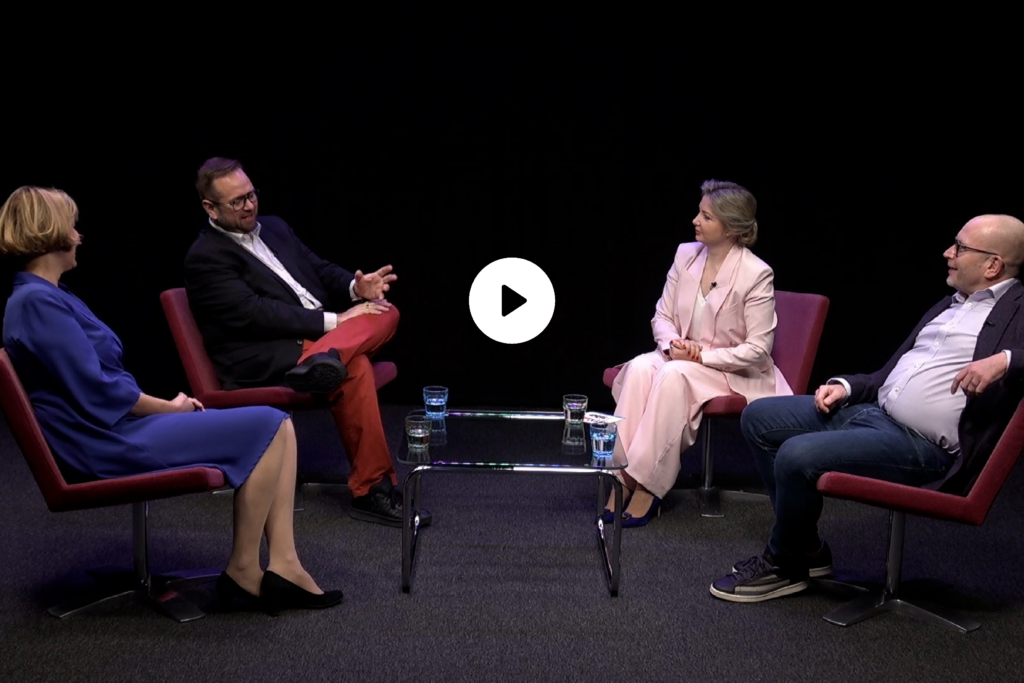
Will machines become more popular managers than humans in the future?
in Finnish with English subtitles:
AI never gets tired or hesitates. AI makes decisions based on data, but can it replace human empathy and inspiration? This question was discussed by Tuomas Meriniemi, Senior Specialist at Tradenomit, Sami Masala, CEO of AIThink, and Johanna Vuori, Principal Lecturer at Haaga-Helia, in a panel discussion moderated by Senior Researcher Anna Lahtinen from Haaga-Helia.
Live broadcast on Yle Areena on 12 November 2025.
Read
in English:
Algorithmic management in the context of organizational leadership and expert work: A Delphi study – Finnish Business Review
10. Conclusion
This book discussed algorithmic management from a variety of perspectives: its history and current state, corporate experiences and researcher observations, future scenarios, and practical recommendations. We have examined AI-based managers as both an opportunity and a risk, as an enhancing force and a threat to humanity. Finally, we wish to reflect on three questions that are particularly relevant at this moment, as algorithmic management becomes increasingly commonplace in expert and knowledge-intensive work. Firstly, it is a good idea to consider what risks may arise as we grant more rights to AI. Secondly, it is important to consider what happens when idealistic promises collide with the everyday reality of organisations. Thirdly, we must also take into account what algorithmic management will mean in legal, human, and financial terms.
10.1 Risks increase along with access rights
In the world of information security, a long-standing practice is the principle of Least Privilege Access (LPA). Its core idea is simple: systems and users should only be granted access to the resources they need to perform a specific task – and no more. It is not a precautionary principle, as it is based on not only research but also empirical observations. Excessively broad access rights are among the most common sources of information security vulnerabilities and misuse, and humans represent the greatest security risk in most organisations. The same logic can also likely be extended to AI and algorithmic management.
When organisations adopt algorithmic management systems, the temptation is to grant them extensive access to various types of data: calendar and scheduling information, performance evaluations, communications and marketing, location data, well-being indicators, and personnel registers. Technically speaking, it is not only possible but also easy. From the organisation’s perspective, it may even seem justified, as the more data a system has access to, the better it can draw conclusions from it. However, this thought can be misleading. In the case of AI, broader access to different databases will not automatically lead to better decisions or smarter management – instead, it increases information security risks, creates more opportunities for privacy violations, complicates legal obligations, and expands organisational responsibility.
Every data stream that an algorithmic system has access to is an opportunity for misinterpretation, harmful profiling, and even misuse – be it unintentional or intentional. The results of our survey are unequivocal in this respect. Both employees and managers draw a clear line between what data they are willing to share with algorithmic management systems. Most would share their working time logs and workload information, but they would not consent to video surveillance, audio recordings, email content scanning, and biometric tracking. This boundary is not entirely arbitrary, as it reflects the fundamental distinction between coordinating work and excessively monitoring a person.In practice, applying the LPA principle to algorithmic management means that, before granting the system access to any data, one must assess whether the data is necessary for the specific management task at hand. Access rights should be limited according to the roles of each system, and not all data should be shared with all systems. At the same time, these access rights should be regularly reassessed, as a need that was justified six months prior may no longer be relevant today. This is not only a technical detail, but also a management principle.
10.2 Current state and desired future state
The public debate on algorithmic management often features two opposing views that largely talk past each other. In the first, optimistic view, algorithmic management is a solution to many of the pain points in supervisory work. It eliminates the influence of friendships, treats everyone equally, does not get tired or stressed, and frees up supervisors’ time for genuine interaction. In this vision, AI is a more humane leader than humans – or at least a fairer one. This is undoubtedly an attractive vision, as a system that measures performance without bias, distributes tasks equally, and identifies excessive workloads before the individual does is highly desirable.
At the same time, we must also acknowledge another, much more pessimistic view of algorithmic management that primarily frames it as a tool for exerting control and outsourcing power and difficult decisions to systems whose errors are often impossible to trace and difficult to contest. In this vision, the algorithm does not liberate people but instead excessively monitors them. Both visions are true, which is why neither alone is enough.
The optimistic view underestimates how difficult it is to build a platform that is truly impartial and fair. Algorithms and generative AI are not created in a vacuum, as they reflect the values of their creators and the data used to shape them. Biased data produces biased decisions. In that sense, an impartial algorithm is a promise that requires continuous upgrades to function. The pessimistic vision, on the other hand, underestimates the problems of human management. Today’s management is by no means flawless, fair, or equitable – far from it. Favouritism, your immediate manager’s mood, having a bad day, and hierarchical power structures all affect how work is managed on a day-to-day basis and how management is perceived.
In other words, algorithmic management is not entering a well-functioning world, but one it is expected to fix, which makes assessing it particularly difficult. The middle ground likely lies somewhere between these two visions, though not exactly at their midpoint. While this does not mean a compromise between good and evil, it does necessitate a clear understanding of where algorithms can and cannot benefit us. The recommended actions and research results presented in our book also emphasise this approach. Algorithmic management works best when it is clearly defined, transparent, regularly evaluated, and supplemented with human judgment.
10.3 Legal, human, and financial considerations
Algorithmic management is not just a technological issue – it is also a legal, human, and financial issue, and these three dimensions are inseparable. As a result of regulatory changes, the legal perspective is currently the easiest one to assess. Taken together, the EU’s AI Act, the Platform Work Directive, the General Data Protection Regulation, and national labour legislation form a framework that sets clear boundary conditions for algorithmic management. In principle, automated decision-making is not permitted without human oversight, or at least it is difficult to do so. High-risk systems, which include HR and recruiting applications, must be explainable and auditable. Employees also have the right to know what data is collected about them, for what purpose, and how it is used.
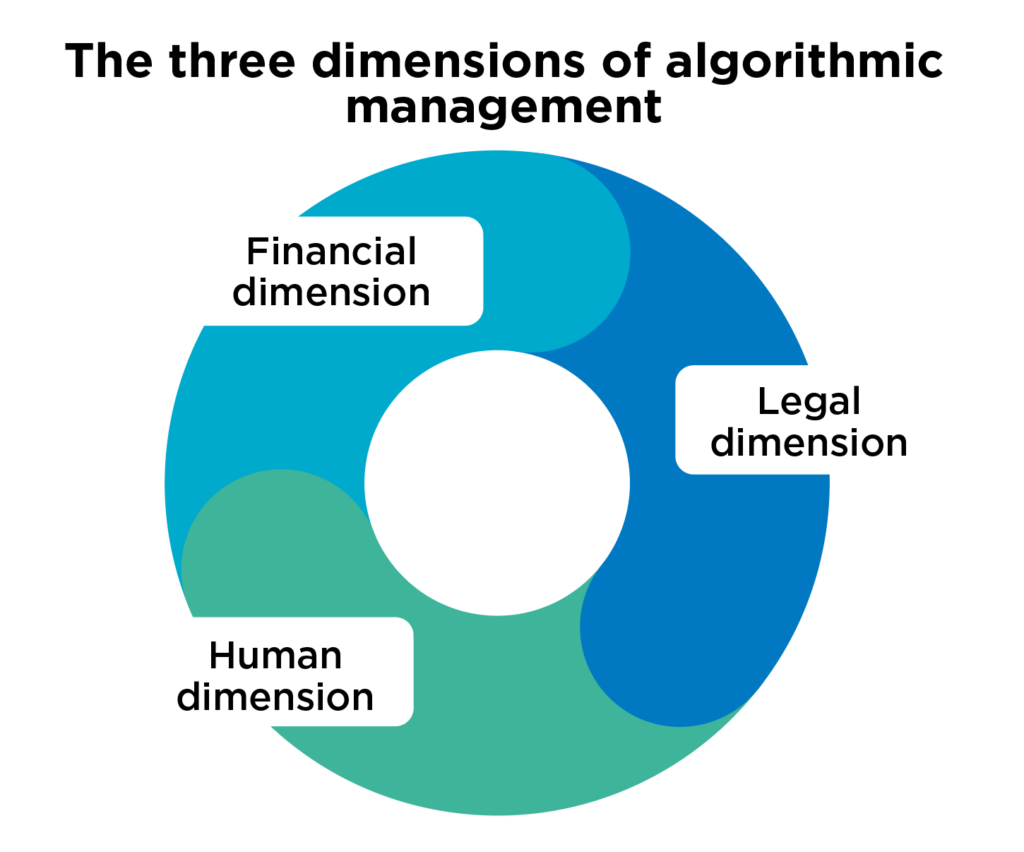
Figure 3. The three dimensions of algorithmic management
This legal framework is necessary, but we must also remember that it represents the absolute minimum rather than an ideal target. The law tells us what we can do, but it does not specify how organisations can best leverage algorithmic management for the benefit of their workers and business objectives. Organisations that understand the purpose of regulation and design their systems to meet this baseline – and slightly exceed it – will build trust not only among their employees but also their customers.
The human perspective is easily ignored when the focus is on technology or legislation. Algorithmic management directly affects people – not just their work processes, but also how they see their work and themselves as employees. It can be stressful to have your work monitored, evaluated and coordinated by a system whose operating logic you do not understand, regardless of whether the system is technically accurate and fair. This represents the human core of management, which cannot be fixed by algorithms: the ability to face another person in a given situation and interpret their gestures to understand what they may not be willing to say aloud. From this perspective, management is less about traditional processes and more about the relationship one has with their supervisor. An algorithm can optimise processes, but it cannot create relationships.
The human perspective also reminds us that algorithmic management affects people in different ways. Younger, more technologically savvy workers may see it as an opportunity. Meanwhile, those with a weaker relationship with their current employer or less experience with digital tools may perceive it as a threat. No algorithm can remove this dynamic – on the contrary, it makes it more visible. That is why an organisation must know who it is managing before it can decide how it will manage them.
The financial perspective is typically the one used to sell algorithmic management to a company’s leadership, with promises of efficiency, automation, and cost savings. Automating routine supervisory tasks frees up time, reduces human errors, and can improve decision-related consistency. In the long run, this may be reflected in productivity, personnel satisfaction, and the organisation’s ability to scale. But some financial benefits come with their own costs. Deployment expenses, training needs, integration challenges, system maintenance, and continuous development demand resources.
If the system leads to resistance to change, eroded trust, or staff turnover, its short-term financial impact may be negative. For this reason, organisations must calculate their overall costs realistically – not only how much money is needed for licences or implementation projects, but also what will happen if the deployment fails in human terms. The financial perspective also forces organisations to ask who will benefit from the change. If algorithmic management results in efficiency gains, how will this be distributed within the organisation? Will the organisation’s increased margins become dividends for its owners, or will they also translate into better working conditions for employees, greater freedom of choice, and new opportunities? As far as we know, there is no right answer to this question, but it is still a question that should be asked within the work community.
10.4 Key takeaways
When you finish this book, we hope that you will continue to think about three things. The first question concerns definition. Algorithmic management is not a uniform phenomenon with a single right answer. It is a collection of different technological solutions that are used for different purposes and that have different consequences. Don’t ask whether you should consider using algorithmic management – instead, you should ask what your concrete management needs are and whether algorithmic management is the most suitable solution.
The second question concerns trust. Trust serves as the foundation of everything, both in society and in workplaces. Our research suggests that organisational trust predicts the acceptance of algorithmic management more strongly than an employee’s technological competence or age. Organisations that have built trust through transparency, inclusion, and humane leadership will have a solid foundation for experimenting with algorithmic management. Without this foundation, the technology will remain unmoored or may even sink due to resistance to change among personnel.
The third question is purely human. It is clear to everyone that while human judgment is not going anywhere, it is currently changing in form. The manager of the future is not the one who performs the most manual and administrative work, but the one who can ask the right questions of data, critically interpret algorithmic recommendations, and meet people where algorithms cannot reach them. This is a competence that has always been needed, and one that people should continue to develop today. AI can lead in many respects, but it is not at its strongest when it comes to managing human experiences of meaning and belonging.
10.5 Summary
This book examines how algorithmic management – i.e. the transfer of decision-making and managerial tasks to automated systems or AI – has been utilised in Finnish expert and knowledge work. The research fills a gap identified in the literature: previous research has primarily focused on platform work, while knowledge work-oriented professions that require judgment, creativity, and interaction have received far less attention. The research data was collected in a multi-method process between 2025 and 2026. The data consists of two national surveys (knowledge workers: n = 1,704, of which 1,156 in expert roles; managers and supervisors: n = 323), a Delphi future scenarios panel, and workshops at five organisations, in four of which Lego Serious Play method was used.
The results demonstrate that algorithmic management is already widespread in Finnish workplaces, with nearly half (49%) of the experts reportedly encountering it in their work. Management style constituted an explanatory factor in the respondents’ attitudes towards algorithmic managers. A flexible algorithm was perceived as more acceptable than a controlling human manager. Algorithms were thought to be more equitable (58%) and better at routine, rule-based tasks. On the other hand, in tasks requiring the management of human relationships, individual support, and evaluation, human managers were considered superior. The strongest predictor of acceptance was not technological competence or age, but trust in the employer and a high-quality supervisory relationship. Based on these results, three key conclusions were made.
Firstly, algorithmic management should be limited to a concrete need in a transparent manner, as technology-driven enthusiasm without a clear idea of what the algorithm should and should not do easily leads to failure. Secondly, building trust through inclusion and humane leadership is a necessary condition for successful deployment, as otherwise the technology will be left without a solid foundation. Thirdly, the role of managers is not disappearing but changing: the manager of the future is, above all, an interpreter and unifying force whose AI literacy will also become a statutory obligation under the EU’s AI Act (2024/1689). The value of human leadership is seen as enduring, particularly where machines are unable to engage with people on a human level.
11. References
- Kauttonen J, Lahtinen A, Tuomi A, Vuori J, Saaranen P. Miten työsi muuttuu, kun kone alkaa tehdä johtajien työtä? [How Will Your Work Change When Machines Start Performing Managers’ Tasks?] Preprint posted online 2025.
- Kim E. Amazon pushes AI use and closely tracks adoption as some engineers push back. Business Insider. Pre-published online in April 2026.
- Finlex. Laki yksityisyyden suojasta työelämässä 759/2004. [Act on the Protection of Privacy in Working Life 759/2004.] Finlex. Published online 2004.
- Björkqvist J, Rummukainen A. Näin pomot valvovat sinua työpaikalla – nämä tapaukset menivät liian pitkälle. [How Employers Monitor You at Work – These Cases Went Too Far] Yle. Published in February 2026.
- Mateescu A, Nguyen A. Algorithmic Management in the Workplace. Data and Society Research Institute. Published 2019.
- Jarrahi MH, Möhlmann M, Lee MK. Algorithmic Management: The Role of AI in Managing Workforces. MIT Sloan Manag Rev. Published 2023:1–5.
- Vuori J, Asikainen M. Kun algoritmi astuu pomon saappaisiin – algoritminen johtaminen työn murroksessa. [When Algorithms Take the Reins: Algorithmic Management in the Transformation of Work] Finnish AI Region. Published in July 2025.
- OECD. Algorithmic Management in the Workplace: New Evidence from an OECD Employer Survey. Published 2025.
- Lahti H, Valtonen T. Algoritminen johtaminen yleistyy Pohjoismaissa – tutkijat varoittavat sen vaikutuksista työntekijöiden hyvinvointiin. [Algorithmic Management Is Becoming More Widespread in the Nordic Countries – Researchers Warn About Its Impact on Employee Well-Being] Finnish Institute of Occupational Health. Published in September 2025.
- Kellogg KC, Valentine MA, Christin A. Algorithms at work: The new contested terrain of control. Academy of Management Annals. 2020;14(1):366-410.
- Parent-Rocheleau X, Parker SK. Algorithms as work designers: How algorithmic management influences the design of jobs. Human Resource Management Review. 2022;32(3):100838.
- McParland, C. & Connolly, R. Employee Monitoring in the Digital Era: Managing the Impact of Innovation. (SSRN Scholarly Paper No. 3492245). SSRN. Published in December 2019.
- European Union. Directive (EU) 2024/2831 of the European Parliament and of the Council of 23 October 2024 on improving working conditions in platform work. Official Journal of the European Union. Published 2024.
- Tuomi A, Jianu B, Hua M, Roelofsen M, Ascencao MP. Strategies for communicating and mitigating algorithmic control on delivery platforms. Convergence: The International Journal of Research into New Media Technologies. Published 2024.
- Finlex. Occupational Safety and Health Act 738/2002. Published 2002.
- Meijerink J, Bondarouk T. The duality of algorithmic management: Toward a research agenda. Human Resource Management Review. Published 2023.
- Ananny M, Crawford K. Seeing without knowing: Limitations of the transparency ideal and its application to algorithmic accountability. New Media Soc. 2018;20(3):973-989.
- Lee MK, Kusbit D, Metsky E, Dabbish L. Working with machines: The impact of algorithmic and data-driven management on human workers. In Proceedings of the CHI Conference on Human Factors in Computing Systems. 2015:1603-1612.
- Rosenblat A, Stark L. Algorithmic labor and information asymmetries: A case study of Uber drivers. Int J Commun. 2016; 10:3758-3784.
- Wood AJ, Graham M, Lehdonvirta V, Hjorth I. Good gig, bad gig: Autonomy and algorithmic control in the global gig economy.Work, Employment and Society. 2019;33(1):56-75.
- Colquitt JA, Conlon DE, Wesson MJ, Porter CO, Ng KY. Justice at the millennium: A meta-analytic review of organizational justice research. Journal of Applied Psychology. 2001;86(3):425-445.
- Bucher T. If… Then: Algorithmic Power and Politics. Oxford University Press; 2018.
- Carnegie M. Gig Workers Are Getting Crushed by the Review Mill. Wired. Published in December 2022.
- European Union. Regulation (EU) 2024/1689 of the European Parliament and of the Council laying down harmonised rules on artificial intelligence (Artificial Intelligence Act). Official Journal of the European Union. Published 2024.
- Palmer A. How Amazon keeps a close eye on employee activism to head off unions. CNBC. Published in October 2020.
- Sainato M. “You feel like you’re in prison”: Workers Claim Amazon’s Surveillance Violates Labor Law. The Guardian. Published in May 2024.
- Bansal V. Amazon is determined to use AI for everything – even when it slows down work. The Guardian. Published in March 2026.
- Gillespie, N., Lockey, S., Ward, T., Macdade, A., & Hassed, G. Trust, attitudes and use of artificial intelligence: A global study 2025.The University of Melbourne and KPMG. Published online 2025.
- Long, D., & Magerko, B. What is AI literacy? Competencies and design considerations. Proceedings of CHI Conference on Human Factors in Computing Systems. Published in April 2020.
- Haggren, J. EU AI Act tekee tekoälylukutaidosta pakollisen osaamisen. [EU AI Act Makes AI Literacy a Mandatory Competence.] eSignals Pro. Published in November 2025.
- Asikainen, M. Tekoälylukutaito – kilpailuetu vai lakisääteinen rasite? [AI Literacy – Competitive Advantage or Statutory Burden?] Finnish AI Region. Published in February 2026.
- Immonen J. Johtajana tietokone: algoritmisen johtamisen vaikutuksia työntekijöihin. [Computer as Manager: The Effects of Algorithmic Management on Employees] 2024.
- Tuomi A, Tussyadiah I, Stienmetz J. Leveraging LEGO® Serious Play® to embrace AI and robots in tourism. Ann Tour Res. 2019; 81:102736.
- Tuomi A, Zainal-Abidin H. Local perspectives on preferable tourism futures: insights from Finland and Japan. Journal of Tourism Futures. Published 2025.
- Cuhls K, Evers KE. Argumentative Delphi surveys: Lessons for sociological research. The American Sociologist, 2024;55(2):120–141. doi:10.1007/s12108-023-09596-x
- Hietikko H. Algoritmi työsuhteisen työntekijän valvojana ja johtajana – algoritmisen johtamisen oikeudelliset reunaehdot kansallisessa kontekstissa [Algorithmic Management of Employees: Legal Boundaries of Algorithmic Management in a National Context]. Master’s thesis. Helsinki: University of Helsinki; 2024.
12. Literature on the topic
RoboBoss is a project whose themes and results have been featured across a wide range of channels, from articles and blogs to videos and nationwide media discussions. The research and its findings have also been presented to academic and professional audiences in various organisations, events, seminars, conferences and networks.
This chapter brings together the project’s key publications, media highlights and presentations. The publications and media selections provide opportunities to explore the research content in greater depth, while the presentations illustrate how the findings have been communicated and their impact across different audiences. The content is arranged with the most recent items first.
12.1 Articles, blogs and other publications
Asikainen, M. (2026, 8 July). When the Algorithm Joins the Boardroom: Finnish Leaders Weigh AI’s New Role in Strategy Work. Finnish AI Region.
Lahtinen, A., Hassinen, S., Broms, U., Jääskeläinen, A., Niemi, K., Nylund, M., Wiklund, J., & Asikainen, M. (2026, 25 June). Tekoäly johtajana – miten rakennetaan luottamusta ja hyvinvointia? [AI as a Manager – How Can We Build Trust and Well-Being?]. SuomiAreena;196, 2026. MTV Katsomo. Also available on the Haaga-Helia University of Applied Sciences YouTube channel, with English subtitles here.
Tuomi, A. & Vuori, J. (2026, 1 June). Algorithmic management in the context of organizational leadership and expert work: A Delphi study. Finnish Business Review. Jyväskylä University of Applied Sciences.
Asikainen, M. (2026, 5 May). Cold but Fair? Algorithmic Management in the Workplace. Finnish AI Region.
Tuomi, A., Pakalén, J., & Schmidt, A. L. (2026, 13 April). Algorithmic management in service business frontlines. Haaga-Helia eSignals Pro.
Lahtinen, A. & Kauttonen J. (2026, 1 January). Tekoälypomo voi vähentää yrityksen kaveripolitiikkaa [An AI Boss Could Reduce Favoritism in Companies]. Opinion article. Kauppalehti [Finnish business newspaper].
Asikainen, M. (2025, 12 December). Don’t Call Me! Why Gen Z and Algorithmic Management Could Be a Perfect Match? Finnish AI Region.
Tuomi, A. (2025, 4 December). Asiantuntijat tekoälypomon alaisuudessa: kuka haluaa osallistua algoritmijohtamisen työkalujen käyttöönottoon, kuka epäröi? [Experts Under an AI Boss: Who Wants to Participate in Deploying Algorithmic Management Tools, and Who Hesitates?]. Sytyke, 4/2025.
Lahtinen, A., Hassinen, S., Kevari, J., Niinistö-Sivuranta, S., Salla, A., Asikainen, M., Meriläinen, J., & Yli-Ketola, H. (2025, 19 November). Koneet johtajina #3 – Miten voit hyvin tekoälypomon alaisuudessa?[Machines as Managers #3 – How Can You Thrive Under an AI Boss?]. Yle Areena. Available on the Haaga-Helia University of Applied Sciences YouTube channel, with English subtitles here.
Lahtinen, A., Masala, S., Meriniemi, T., Vuori, J., Asikainen, M., Meriläinen, J., & Yli-Ketola, H. (2025, 12 November). Koneet johtajina #2 – Onko tulevaisuudessa kone ihmisjohtajaa suositumpi? [Machines as Managers #2 – Could a Machine Become More Popular Than a Human Manager in the Future?]. Yle Areena. Available on the Haaga-Helia University of Applied Sciences YouTube channel, with English subtitles here.
Lahtinen, A., Bergström, N., Kurkijärvi, L., Niemi-Hugaerts, H., Asikainen, M., Meriläinen, J., & Yli-Ketola, H. (2025, 5 November). Koneet johtajina #1 – Kuka päättää johtaako työtäsi kone vai ihminen? [Machines as Managers #1 – Who Decides Whether Your Work Is Managed by a Machine or a Human?]. Yle Areena.Available on the Haaga-Helia University of Applied Sciences YouTube channel, with English subtitles here.
Asikainen, M. (2025, 2 November). AI as Sparring Partner, Not Replacement: Why Algorithms Can Be Fairer Managers Than Humans. Finnish AI Region.
Asikainen, M. (2025, 2 November). An Algorithm as Boss? Nearly Half of Finns Have Already Experienced AI Management. Finnish AI Region.
Lahtinen, A. (2025, 9 August). Tekoälypomot hiipivät työpaikoille huomaamatta [AI Bosses Are Quietly Creeping into Workplaces]. Opinion article. Helsingin Sanomat [Finland’s largest daily newspaper].
Asikainen, M. & Vuori, J. (2025, 17 July). When Algorithms Take the Reins: How Digital Management is Reshaping the Future of Work. Finnish AI Region.
Lahtinen, A., Kurkijärvi, L., Bergström, N., Masala, S., Meriniemi, T., Niemi-Hugaerts, H., & Asikainen, M. (2025, 27 June). Koneet johtajina – kuka määrää työelämässä? [Machines as Managers – Who Is in Charge in Working Life?]. SuomiAreena; 182, 2025. MTV Katsomo. Available on the Haaga-Helia University of Applied Sciences YouTube channel, with English subtitles here.
Asikainen, M. (2025, 17 June). Algorithmic management spreads across Finnish workplaces – younger workers show greater acceptance than their older colleagues. Finnish AI Region.
Vuori, J. & Asikainen, M. (2025, 2 June). Kun algoritmi astuu pomon saappaisiin [When the Algorithm Steps into the Boss’s Shoes]. Henry.
Tuomi, A. & Ascenção, M. P. (2025, 7 April). Managed by a robot: Exploring acceptable use cases of algorithmic management through LEGO Serious Play. Haaga-Helia eSignals Pro.
Asikainen, M. & Kauttonen, J. (2025, 20 March). Types of Algorithms and Their Applications. Finnish AI Region.
Asikainen, M. & Kauttonen, J. (2025, 20 March). What Algorithms Are and What You Should Know About Them. Finnish AI Region.
12.2 News and Media
HR-viesti [HR-message]. (2026, 10 July). Joka kolmas johtaja uskoo tekoälyn päihittävän ihmisen strategiatyössä – uusi tutkimus paljastaa algoritmijohtamisen realiteetit [One in Three Leaders Believes AI Will Outperform Humans in Strategy Work – New Study Reveals the Realities of Algorithmic Management]. HR-viesti [HR-message].
Keurulainen, M. (2026, 6 July). SuomiAreena: Tekoäly voi viedä työpaikkoja, mutta annammeko sen tehdä niin? [SuomiAreena: AI May Take Jobs, but Will We Let It?]. Haaga-Helia University of Applied Sciences & STT Info.
Nylund, M. (2026, 1 July). Tekoäly ei ole parempi johtaja, mutta se haastaa johtamisen perusteita [AI Is Not a Better Leader, but It Challenges the Fundamentals of Leadership]. Gofore.
Innohub. (2026, 29 June). Tekoäly johtajana – miten rakennetaan luottamusta ja hyvinvointia? | SuomiAreena 2026 [AI as a Manager – How Can We Build Trust and Well-Being? | SuomiAreena 2026]. Innohub.
Foibekartano. (2026, 26 June). Tekoäly johtajana – miten rakennetaan luottamusta ja hyvinvointia? [AI as a Manager – How Can We Build Trust and Well-Being?]. Foibekartano.
Erholtz, S. (2026, 18 June). Tekoäly toiminnan peilinä – mahdollisuus viranomaistyön siilojen murtamiseen[AI as a Mirror of Operations – An Opportunity to Break Down Silos in Public Authority Work]. Ministry of the Interior [Sisäministeriö]. Prime Minister’s Office [Valtioneuvoston kanslia].
Keurulainen, M., Lahtinen, A., & Asikainen, M. (2026, 12 June). Joka kolmas johtaja uskoo tekoälyn päihittävän ihmisen strategiatyössä – uusi tutkimus paljastaa algoritmijohtamisen realiteetit [One in Three Leaders Believes AI Will Outperform Humans in Strategy Work – New Study Reveals the Realities of Algorithmic Management]. Kauppalehti [Finnish business newspaper].
Keurulainen, M., Lahtinen, A., & Asikainen, M. (2026, 10 June). Joka kolmas johtaja uskoo tekoälyn päihittävän ihmisen strategiatyössä – uusi tutkimus paljastaa algoritmijohtamisen realiteetit [One in Three Leaders Believes AI Will Outperform Humans in Strategy Work – New Study Reveals the Realities of Algorithmic Management]. Haaga-Helia University of Applied Sciences & STT Info.
Asikainen, M. (2026, 28 May). Haaga-Helia Joins SuomiAreena for the Second Time – This Year with Two Separate Stage Events. Haaga-Helia University of Applied Sciences & STT Info.
Asikainen, M. (2026, 15 May). Tekoäly johtajana – miten rakennetaan luottamusta ja hyvinvointia? [AI as a Manager – How Can We Build Trust and Well-Being?]. Haaga-Helia University of Applied Sciences.
Rissanen, A. (2026, 4 May). Tekoälykuulumisia Haaga-Heliasta 5/2026 [AI News from Haaga-Helia 5/2026]. Newsletter. Haaga-Helia University of Applied Sciences.
Cygnel, S. (2026, 28 April). Johtamisen neljä kulmakiveä [The Four Cornerstones of Leadership]. Telma-journal.
Rissanen, A. (2026, 4 April). Tekoälykuulumisia Haaga-Heliasta 4/2026 [AI News from Haaga-Helia 4/2026]. Newsletter. Haaga-Helia University of Applied Sciences.
Malminen, U. (2026, 23 March). Mikään ala ei ole ”turvassa” tekoälyltä – näin sen kanssa tulee toimeen [No Industry Is “Safe” from AI – How to Cope with It]. Yle News.
Ylinen, I. (2026, 19 March). Kone johtajan paikalla [A Machine in the Leader’s Seat]. Finnish Professional Coaches. Saval Pro Coach. Asia-journal.
Asikainen, M. (2026, 19 January). What Happens in the Workplace When Machines Start Managing? – Panel Discussion for Students on the Future of Work. Haaga-Helia University of Applied Sciences.
The Finnish Work Environment Fund. (2026, 15 January). Tekoäly muuttaa työelämää – algoritmit johtavat ja tekoäly auttaa etsimään töitä [AI Is Transforming Working Life – Algorithms Manage and AI Helps People Find Jobs]. The Finnish Work Environment Fund.
Grym, P., Laakasuo, M., Lahtinen, A., & Pajunen, A. (2025, 17 December). Hyväksyisimmekö tekoälyn tekemät eutanasiapäätökset? [Would We Accept Euthanasia Decisions Made by AI?]. Kulttuuriykkönen [Yle Radio 1 cultural affairs programme]. Yle Radio 1 & Yle Areena.
Masala, S. (2025, 11 December). Could machines become more popular leaders than humans? – Thoughts from Episode 2. AIThink. Reaktor Ecosystem.
Innohub. (2025, 10 December). Koneet johtajina #1: Kuka päättää johtaako työtäsi kone vai ihminen?[Machines as Managers #1: Who Decides Whether Your Work Is Managed by a Machine or a Human?]. Innohub.
The Finnish Work Environment Fund (2025, 9 December). Kutsu Tutkimus tutuksi -tilaisuuteen 15.1.2026: Tekoäly – työn tuhoaja vai rikastuttava työväline? [Invitation to the Research Event on 15 January 2026: AI – Destroyer of Jobs or an Enriching Tool?]. ePressi.
Salla, A. (2025, 14 November). Aura Salla mukana Slushissa ja sivutapahtumissa [Aura Salla at Slush and Side Events]. Aurasalla.eu.
Telsu (2025, 10 November). Kanavan Yle Areena ohjelmatiedot keskiviikkona 19.11.2025 [Yle Areena Programming Information for Wednesday, 19 November 2025]. Telsu.fi.
Asikainen, M. (2025, 6 November). Lähes puolet suomalaisista asiantuntijoista on kokenut tekoälypomon – Uusi keskustelusarja Yle Areenassa pureutuu ilmiön taustavaikuttimiin [Nearly Half of Finnish Experts Have Experienced an AI Boss – New Yle Areena Discussion Series Explores the Factors Behind the Phenomenon]. Haaga-Helia University of Applied Sciences.
Rissanen, A. (2025, 6 November). Tekoälykuulumisia Haaga-Heliasta 11/2025 [AI News from Haaga-Helia 11/2025]. Newsletter. Haaga-Helia University of Applied Sciences.
Telsu. (2025, 6 November). Kanavan Yle Areena ohjelmatiedot keskiviikkona 12.11.2025 [Yle Areena Programming Information for Wednesday, 12 November 2025]. Telsu.fi.
Telsu. (2025, 28 October). Kanavan Yle Areena ohjelmatiedot keskiviikkona 5.11.2025 [Yle Areena Programming Information for Wednesday, 5 November 2025]. Telsu.fi.
Kaukonen, H-M. (2025, 27 October). Tekoäly helpottaa sotetyön kirjaamista ja paperityötä [AI Makes Documentation and Paperwork Easier in Health and Social Care]. KT-journal.
Valkama, H. (2025, 23 September). ”Ei ennakkoasenteita eikä kaveripolitiikkaa” – Tekoäly nähdään ihmistä reilumpana johtajana [“No Bias and No Favoritism” – AI Is Seen as a Fairer Leader Than Humans]. Yle News.
Yle. (2025, 4 September). Ihmiset pitävät koneita reiluina johtajina. Uutisvideot 2025. Lähetetty alun perin uutislähetyksessä [People Consider Machines to Be Fair Leaders. News Videos 2025. Originally Broadcast in a News Bulletin]. Yle Areena.
Helakallio, A. (2025, 17 August). Tutkimus paljastaa: Suomalaiset työntekijät epäilevät tekoälyjohtajia [Study Reveals: Finnish Employees Are Sceptical of AI Leaders]. Talouselämä [Finnish business and finance magazine].
Helakallio, A. (2025, 16 August): Tekoäly johtajana? Tutkimus paljastaa, miten suomalaiset työntekijät suhtautuvat [AI as a Leader? Study Reveals How Finnish Employees Feel]. Tekniikka & Talous [Finnish technology and business magazine].
Helakallio, A. (2025, 14 August). Tutkimus paljastaa: Suomalaiset työntekijät epäilevät tekoälyjohtajia [Study Reveals: Finnish Employees Are Sceptical of AI Leaders]. Tietoviikko. TIVI [Finnish IT and technology magazine].
Kujala, J. & Kurkijärvi, L. (2025, 10 August). Älä päästä tekoälyagentteja lentoon varpusparvena – näin rakennat tekoälyn lennonjohtotornin [Don’t Let AI Agents Take Flight Like a Flock of Sparrows – How to Build an AI Control Tower]. Sofigate.
Asikainen, M. (2025, 3 July). Tekoälypomo on kohta suomalaisten arkea, mutta kuka määrittelee eettiset pelisäännöt? [AI Bosses Will Soon Be Part of Everyday Life in Finland, but Who Defines the Ethical Ground Rules?]. Haaga-Helia University of Applied Sciences & STT Info.
Innohub. (2025, 2 July). Koneet johtajina – kuka määrää työelämässä? | SuomiAreena 2025 [Machines as Managers – Who Is in Charge in Working Life? | SuomiAreena 2025]. Innohub.
Meriniemi, T. (2025, 1 July). Tradenomi, tuntuuko että työtäsi johtaa tekoäly? – Mitä on algoritmijohtaminen?[BBA Graduate, Does It Feel Like AI Is Managing Your Work? – What Is Algorithmic Management?]. Tradenomiliitto [Professionals of Business and Technology].
Masala, S. (2025, 27 June). AIThink at SuomiAreena: What happens when leadership is handed over to algorithms?. Reaktor Ecosystem.
Asikainen, M. & Lahtinen, A. (2025, 23 June). Haaga-Helia SuomiAreenassa: Mitä tapahtuu, kun yhä suurempi osa johtamisesta siirtyy tekoälylle? [Haaga-Helia at SuomiAreena: What Happens When an Increasing Share of Management Is Handed Over to AI?]. Haaga-Helia University of Applied Sciences & STT Info.
Väisänen, K. (2025, 17 June). Kone on ihmistä oikeudenmukaisempi pomo – algoritmiin perustuva johtaminen jo yleistä, ainakin keskisuurissa yrityksissä [A Machine Is a Fairer Boss Than a Human – Algorithm-Based Management Is Already Common, at Least in Medium-Sized Companies]. TTT-journal.
Asikainen, M. & Lahtinen, A. (2025, 16 June). Algorithmic management spreads across Finnish workplaces – younger workers show greater acceptance than their older colleagues. Haaga-Helia University of Applied Sciences, STT Info & Finnish AI Region.
Insinööriliitto [The Union of Professional Engineers in Finland]. (2025, 3 June). Valtakunnallinen tutkimus kartoittaa tekoälyn roolia johtamistehtävissä [Nationwide Study Maps the Role of AI in Management Tasks]. Insinööriliitto [The Union of Professional Engineers in Finland].
Henry [Finnish Association for Human Resource Management]. (2025, 28 May). Vastaa 4.6. mennessä – valtakunnallinen tutkimus kartoittaa tekoälyn roolia johtamistehtävissä [Respond by 4 June – Nationwide Study Maps the Role of AI in Management Tasks]. Henry [Finnish Association for Human Resource Management].
KEUKE [Central Uusimaa Business Development Centre]. (2025, 28 May). Vastaa kyselyyn: Miten tekoäly vaikuttaa johtamiseen ja asiantuntijatyöhön? [Take the Survey: How Does AI Affect Management and Expert Work?]. KEUKE.
TIEKE [Finnish Information Society Development Centre] (2025, 28 May). Vastaa 4.6. mennessä – valtakunnallinen tutkimus kartoittaa tekoälyn roolia johtamistehtävissä [Respond by 4 June – Nationwide Study Maps the Role of AI in Management Tasks]. TIEKE.
TIEKE [Finnish Information Society Development Centre] (2025, 26 May). TIEKE mukana SuomiAreenassa: Mitä tapahtuu, kun yhä suurempi osa päätöksenteosta siirtyy algoritmeille? [TIEKE at SuomiAreena: What Happens When an Increasing Share of Decision-Making Is Handed Over to Algorithms?]. TIEKE.
Asikainen, M. & Lahtinen, A. (2025, 21 May). Haaga-Helia mukana SuomiAreenassa: Mitä tapahtuu, kun yhä suurempi osa päätöksenteosta siirtyy algoritmeille? [Haaga-Helia at SuomiAreena: What Happens When an Increasing Share of Decision-Making Is Handed Over to Algorithms?]. Haaga-Helia University of Applied Sciences.
The Finnish Work Environment Fund. (2025, 21 May). Kymmenen teemahanketta tutkii tekoälyn hyödyntämistä työelämässä [Ten Thematic Projects Study the Use of AI in Working Life]. The Finnish Work Environment Fund.
Lahtinen, A. & Rissanen, A. (2025, 3 April). Is the future led by an algorithm? – Haaga-Helia studies the role of AI in working life. Haaga-Helia University of Applied Sciences & STT Info.
Asikainen, M. & Lahtinen, A. (2025, 5 March). When Algorithms Become Managers: New Study Examines AI’s Role in Finnish Workplace Leadership. Haaga-Helia University of Applied Sciences.
12.3 Presentations, talks and workshops
Vuori, J. (2026, 23 April). Onko tekoälystä pomon saappaisiin? [Can AI Fill the Boss’s Shoes?] Webinar. Finnish Association of Development Agencies – SEKES (online).
Lahtinen, A. (2026, 7 April). AI – managing change or change in management? Leading People -course, Haaga-Helia (Helsinki, Finland).
Tuomi, A. & Vuori, J. (2026, 26 March). Algorithmic management in the context of organizational leadership and expert work: A Delphi study. Theory and Practice conference (Kouvola, Finland).
Tuomi, A. (2026, 18 March). Tekoäly johtamisessa ja mikroyrittäjän arjen tehostajana: Haaga-Helian Kone johtajana –hanke. [AI in Management and as a Tool for Streamlining the Daily Work of Micro-Entrepreneurs: Haaga-Helia’s RoboBoss Project]. Webinar. Business Mentors Finland (online).
Lahtinen, A. (2026, 12 March). Johtaminen ja oppiminen tekoälyaikana. [Leadership and Learning in the Age of AI]. Webinar. Team Academy Global (online).
Lahtinen, A. (2026, 10 March). Tekoäly ja toimistotyö. [AI and Office Work] Trade Union for the Public and Welfare Sectors JHL (online).
Lahtinen, A. (2026, 4 February). What happens when AI is the boss? Duuniin.net (Helsinki, Finland).
Lahtinen, A. (2026, 15 January). Tekoäly asiantuntija- ja tietotyön johtamisessa. [AI in the Management of Expert and Knowledge Work]. Research Awareness Event. The Finnish Work Environment Fund. (Helsinki, Finland).
Lahtinen, A. (2025, 9 December). Tekoäly esihenkilönä – 2030-luvun työelämän uusi normaali. [AI as a Supervisor – The New Normal of Working Life in the 2030s]. Event for Fujitsu Finland management and employees. Fujitsu (Helsinki, Finland).
Vuori, J. (2025, 2 December). Humans vs. Machines: Employee Perceptions of Algorithmic Management and Leadership in Knowledge Work (Kauttonen, J., Lahtinen, A., Tuomi, A., & Vuori, J.) International Studying Leadership conference 2025 (St. Andrews, Great Britain).
Vuori, J. & Lahtinen, A. (2025, 31 October). Kone johtajana – tekoäly asiantuntija- ja tietotyön johtamisessa. [Machine as a Manager – AI in the Management of Expert and Knowledge Work]. Meeting of Library Directors and Managers of Uusimaa (online).
Lahtinen, A. (2025, 30 October). Tekoäly esihenkilötyössä. [AI in Supervisory Work]. Workshop for Haaga-Helia management (Helsinki, Finland).
Lahtinen, A. (2025, 23 October). Tekoäly esihenkilönä? Vaikutukset johtamiseen ja sen vastuullisuus. [AI as a Supervisor? Implications for Leadership and Responsible Management]. Healthy Work Conference. Finnish Institute of Occupational Health (studio broadcast, online).
Lahtinen, A. (2025, 18 September). Piloteista arvoon – tekoälyn murros johtamisessa. [From Pilots to Value – The AI Transformation in Management]. Management event. Kesko (Helsinki, Finland).
Lahtinen, A. (2025, 9 September). Kone johtajana – tuloksia kentältä. [Machine as a Manager – Findings from the Field] Business Event of the AI Scale-Ups Project (Helsinki, Finland).
13. Authors

Anna Lahtinen, DBA, Senior Researcher, RoboBoss Project Manager, Founder of the Human-Driven AI Research Group, Haaga-Helia, Helsinki. Specialised in the transformative effects of AI on working life, businesses, and careers, Anna Lahtinen’s experience spans over two decades in industry, entrepreneurship, innovation ecosystems, and academia, both in Finland and abroad. She has been at the forefront of supporting the adoption of AI in businesses and organisations. In the video interviews series AI in Finland, Lahtinen interviews Finnish influencers and leaders about their experiences with AI.

Aarni Tuomi, PhD, Principal Lecturer in service business at Haaga-Helia, focusing on digital services and service design. His research has surveyed the future of working life, especially from the perspectives of AI, service robotics, the platform economy, and algorithmic management.

Janne Kauttonen, PhD, Senior Researcher at Haaga-Helia. He defended his doctoral dissertation in the field of theoretical physics in 2012 and has since carried out interdisciplinary research in neuroscience, cognitive science, and data science. He focuses especially on data analysis, computational methods, and the application and deployment of AI in organisations. His other special interests include natural language analysis and generative AI methods.

Johanna Vuori, PhD, is a Principal Lecturer at Haaga-Helia and a Docent at the University of Helsinki. Her research and teaching focuses on management and organisations. She has published in several international scientific journals on topics such as middle management work and self-managing organisation. In addition to algorithmic management, her current research focuses on communality amidst the digital transformation. She has wide-ranging experience in the preparation and management of extensive research projects.

Martti Asikainen is an AI educator and communications expert in the field of entrepreneurship and business renewal at Haaga-Helia. He specialises in responsibility- and influencing-oriented communication in particular. For the past four years, Asikainen has primarily worked in research, development, and innovation projects promoting AI, business renewal, and sustainable development.
14. Partners
This book forms part of the research project “RoboBoss – AI in the Leadership of Knowledge Work and Expert Roles” (2025–2026). It brings together the project’s key research phases, findings, and insights in the form of a final report. The project studied algorithmic management, particularly in expert and knowledge-intensive work – areas in which the role of AI has so far been only minimally studied and understood. The project was implemented by Haaga-Helia with the support of the Finnish Work Environment Fund, companies, and an extensive partner network.